

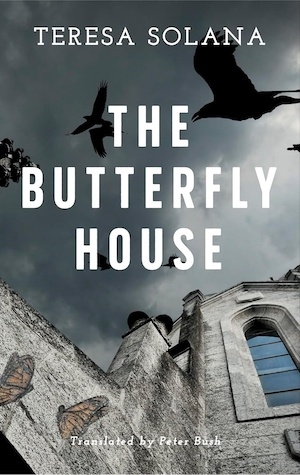
We tend to think of Barcelona as a flamboyant, opulent and romantic European city, but you can trust that in crime fiction you will discover what lies beyond the façade. Teresa Solana’s new novel, The Butterfly House, seems the perfect place to start.
Translated by Peter Bush, the book is released on 12 September 2026, and in its pages we’ll visit the city during the economic crisis that began in 2008. Flamboyance and opulence are not the reality for many in Barcelona, and students are squatting in a grand old house which is now run down. Property developers have their vulture eyes on places like this, or someone with no money and no future could have done it. Perhaps it was some kind of beef, or a crime of passion.
For police detective Norma Forester – half Catalan, half British – the job is not to speculate but to find the evidence and catch the killer. The only slight problem is that her own daughter was recently at the squat.
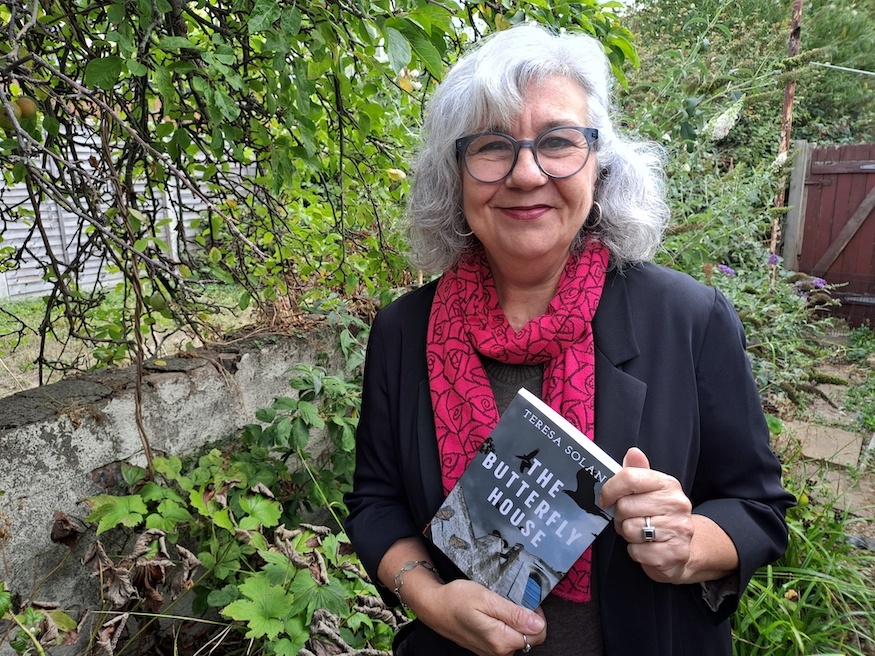
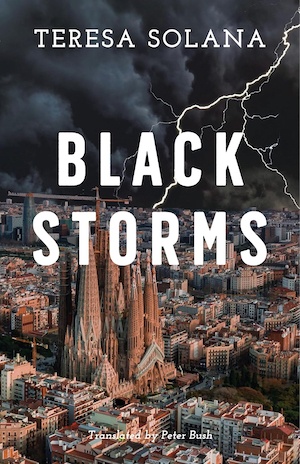
The novel follows Black Storms, which arrived in English two years ago and something we noticed was Teresa Solana’s sly and very dark sense of humour shining through in that mystery. A skilled literary translator, she began writing novels in 2004 in Barcelona, and now lives in Bristol in the UK. Anyone who has won an award for a story called I Detest Mozart will immediately catch our interest. So we decided to ask Teresa to join us here on Crime Fiction Lover to share a little more information about The Butterfly House, and how it came to be.
What are crime fiction lovers going to love about The Butterfly House?
The peculiar characters of the family of Norma Forester, the main character in the series. And, of course… the plot.
Who is Norma Forester, what inspired her and how have you developed this character?
Norma is the granddaughter of a woman belonging to the Catalan bourgeoisie and an Englishman who enlisted the International Brigades and fought in Spain during the Civil War. She is a fictional character inspired by many real women.
What’s she up against in The Butterfly House?
The story revolves around the squat where Norma’s daughter lives. Violeta is an idealistic young woman, like her grandfather. As for who the bad guys are, that’s for the reader to decide!
Who are some of the other key characters we’ll get to meet and how do they influence the story?
Norma is not a lonely and traumatised detective who spends her nights drinking whisky. She is a daughter, a wife and a mother. Her family is very important to her, so they become characters in the story, particularly her husband, who is a forensic doctor and the brother of Violeta’s biological father. Norma’s team are also important and reflect different aspects of Catalan society. Ah, and Norma has an occasional lover…
Tell me about the period and the setting, and the role these play in the story and its atmosphere?
I wrote this novel after the crash of 2008, caused by the subprime mortgage crisis. The crisis lasted several years, and these are the years when the novel takes place, the years when people were force to struggle with unemployment and poverty.
In Black Storms you pulled strings that went back to the Spanish Civil War. What are some of the bigger themes you wanted to explore in The Butterfly House?
I wanted to depict Barcelona during the years of the economic downturn and the fight waged by many young people against real estate profiteering. I suppose you could say that the main theme is greed and how greed destroys everything.
Black Storms was remarked upon for its quirky humour. How have you used humour in The Butterfly House and what role does it have in the overall feeling you wanted to create?
It’s more vitriolic and I think some of the characters and situations will make readers smile.
What has the response to Black Storms been like from readers in English?
I think it has been very, very positive, because through this book they encountered characters that are quite Mediterranean and discovered aspects of Barcelona you don’t find in travel guides.
Which other crime books and/or authors have influenced you and what are you reading right now? Are there any other Catalan crime authors we need to look out for?
As a translator, I’ve translated a lot of thrillers. I started reading the classics like Christie, Chesterton and Conan Doyle, but I think that the authors that have influenced me most are the Mediterranean ones such as Manuel Sánchez Montalbán, Andrea Camilleri, Francisco González Ledesma, Alicia Giménez Bartlett, Petros Márkaris… I also like very much the books of Gene Kerrigan and Ian Rankin. Unfortunately most of my favourite Catalan writers – Rafael Tasis, Manuel de Pedrolo, Llort – are untranslated.
What’s next for DI Norma Forester and what’s next for Teresa Solana?
The next novel in the series, soon to be translated into English, is called October. It revolves around the investigation of a murder that takes place in the days leading up to the independence referendum held in Catalonia on 1 October 2017. As for what’s next, I’m currently writing short, dark stories.
The Butterfly House is published 12 September 2026 in print and for Kindle by Corylus Books, and you can guarantee your copy using the buttons below.