


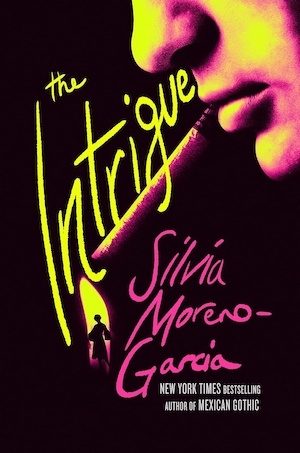
Mexican-Canadian author Silvia Moreno-Garcia has the uncanny ability to jump effortlessly between genres. Gothic horror, fantasy adventure, historical fantasy or sci-fi, magic realism, vampire noir, crime noir, coming-of-age or historical drama, she’s done it all. With The Intrigue, she presents us with a combination of Mexican crime fiction, rural noir and even a hint of pulp set partly during World War II.
Ulises Linares operates under many names, shifting his identity depending on the town he finds himself in. At 29, his silver-streaked hair gives him the look of a young Errol Flynn, allowing him to pass for older or younger depending on his target. Ulises is a con artist and, just like his father before him, a remarkably good one.
But Ulises knows his looks won’t last. Desperate to secure a rich woman’s fortune, he sets his sights on Puerco Ahogado, a small mountain town in Veracruz, Mexico. His target is Perla Inclán, the owner of a local boardinghouse, who he has been wooing through an exchange of letters. Believing her to be a lonely, desperate sitting duck, Ulises arrives in town to seal the deal, only to find she is far from enthusiastic to meet her chivalrous prince. On the contrary, she keeps him at a distance and treats him like just another paying guest.
The situation grows more complicated with the presence of Perla’s niece, Inés. Sharp, perceptive and cynical, Inés is desperate to escape her aunt’s iron fist. Taken in by Perla after her mother died from a fall down the stairs, Inés nevertheless has plenty of reason to despise her aunt. Perla never forgave her sister for running away as a teenager with the man Perla loved and she diverts all her pent-up hatred towards Inés, constantly reminding her of her mother’s missteps and her status as an illegitimate child. Trapped in this environment, Inés feels like a wild animal kept caged in a menagerie.
Puerco Ahogado is a small town filled with small-minded people, a claustrophobic place that suffocates anyone who cannot find a way out. Remaining an unmarried spinster means letting the community suck the joy out of you. Perla insists that her home is “…a noble house, a proper house, and we are proper people.” She keeps up appearances while local scandals are quietly suppressed and hidden. Yet, the entire town knows about Miss Inclán’s correspondence with a man from Mexico City through a lonely heart’s mailbox.
Perla is no pushover. She holds secrets of her own and has lived as anything but a naive spinster. Ulises is not the only man desperate to wed her either. Cándido Soto, the loyal mayor, has been unsuccessfully trying to convince her to marry him, though she refuses to yield to his terms, including his expectation that she live alongside his hypochondriac sister, Lulú.
The characters in Moreno-Garcia’s work are layered, complex and thoroughly convincing. One example is Professor Nepomuceno, an elderly alcoholic and permanent resident of the boarding house who has taught Inés since she was 10. Another example is found in Beto and Bartolo, two enthusiastic police detectives keen to show off their skills. As characters interact, reader sympathies shift constantly, making it hard to decide who the real villains are.
The novel is set primarily in 1943 during World War II, with backstories reaching into the 1910s and 1920s. This 1940s setting coincides with the era when Mexican detective fiction emerged. The story also draws on the tradition of novelas costumbristas – novels dealing with the eccentricities of rural society in the style of pulp fiction and melodramatic telenovelas where desire acts as the driving force of the story.
Whether Moreno-Garcia is reimagining HG Wells’s The Island of Doctor Moreau or crafting a jazz era fantasy steeped in Mayan mythology, her work remains consistently fresh, inventive, and compelling.
For more rural noir, try the more gritty The Devil Takes You Home by Gabino Iglesias.
Del Rey
Print/Kindle/iBook
£12.99
CFL Rating: 4 Stars