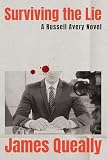


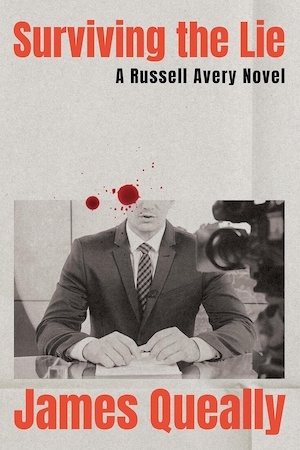
For the final book in his Russell Avery trilogy, Los Angeles Times investigative journalist James Queally returns to New Jersey – the Garden State – with a story which couldn’t be more topical or timely. The series has been dubbed ‘turnpike noir’ after the famous highway connecting the towns and cities of New Jersey to the New York.
Russell Avery used to be a private investigator. Before that he was an investigative journalist. Now he’s a waiter. It’s not the most promising career, but a lot safer than his previous professions – especially for someone like Russell, who didn’t just walk the line between personal safety and chasing a scoop, but jumped right over it.
He’s told his girlfriend, Selene, that he’s more sensible now. Russell understands he has a responsibility not to bring trouble to her door. The difficulty for Russell (and for Selene) is that he’s not actually ready to give it all up. He has a strong sense of justice, and chasing down leads is in his blood. It’s why he’s been missing shifts at the restaurant to do anonymous, largely unpaid, journalism on the side. Writing online with the handle Signal 100, Russell has had a little success exposing corruption in New Jersey.
When Desmond Fox disappears whilst chasing a story, and Fox’s husband asks him to investigate, Russell knows there are plenty of good reasons why he should say no. Fox was more than just a colleague, he was a nationally-recognised star and Russell’s mentor. Fox was also the man who could have stepped in to save Russell’s career but chose not to. The pair haven’t spoken since that betrayal. Why he says yes is just one of the interesting questions this clever novel examines.
Russell’s first lead takes him to a bowling alley run by Kiley McKinnon. He arrives just in time to save McKinnon from being kidnapped by a group of men Russell recognises as belonging to The Line, a direct action group protesting all manner of right-wing hot topics including immigration, reproductive rights and fake news.
The Line has many ex-cops in its membership, and possibly some still on the force. McKinnon’s father, Trace, is also a journalist. His right-wing columns placed him at the opposite end of the political spectrum from the liberal Fox. Trace has also gone missing, a few days it seems before Fox. The pattern is obvious even if the connection between two such different journalists isn’t.
Once it gets going, Surviving The Lie clips along at a fine old pace. There’s plenty of action, peril and Queally doesn’t shy away from the brutality of groups like The Line. However, there is humour too and even some domestic romance. Along the way we visit different New Jersey cities, all lovingly described as only a native like the author could.
What elevates Surviving The Lie is the author’s examination of some key themes in today’s media. On one level the book is a cri de coeur for the state of journalism; papers closing, editors scared of taking risks, proprietors more interested in pushing a political agenda than pursuing the truth. On another there is an examination of the ethics of journalism. What happens when a responsibility to tell the truth has to be balanced against the personal harm this might cause to people.
Queally also investigates the rise of fake news and alternative facts. What happens to a society when the truth is up for grabs? These are all important, complicated questions which the author examines in a way which avoids sermonising, or being patronising, and without getting in the way of the story. The author challenges his protagonist, Russell Avery, to overcome his own personal challenges. Can he temper his own disregard for his own personal safety, and begin thinking of others first? And can he do this while staying true to himself?
Surviving The Lie might bring to an end the Russell Avery story, but readers new to the series shouldn’t be scared of picking it up. I haven’t read either Line of Sight or All These Ashes and it didn’t affect my enjoyment of this novel at all.
Stories about investigative journalists are more important than ever as politicians increasingly attack the free press and violence against journalists increases. Also see Sergio Olguin’s Veronica Rosenthal series which includes The Best Enemy, The Fragility of Bodies, The Foreign Girls and There Are No Happy Loves.
Counterpoint Press
Print/Kindle/iBook
£17.20
CFL Rating: 5 Stars