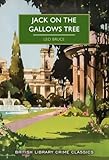


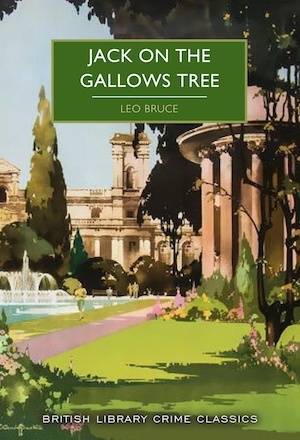
First published in 1960 and now included in the British Library Crime Classics series, Jack on the Gallows Tree is part of the long-running Carolus Deene series. Written by Leo Bruce, the pen name of Rupert Croft-Cooke, the series blends the puzzle mystery traditions of classic British crime fiction with an unusually sharp sense of humour.
Carolus Deene, a senior history master at a boys’ school with a sideline as an amateur criminologist, is forced to take time away from work after falling ill. His headmaster, wary of the crimewave reportedly sweeping England’s seaside resorts, sends him to the inland spa town of Buddington to recover.
Within days of his arrival, Buddington is shaken by a disturbing double murder: two elderly women are found strangled on the same evening, bodies discovered in separate locations, each laid out carefully with a white lily clasped in her hands.
From this unsettling premise, Bruce constructs a mystery that is both playful and surprisingly intricate. The victims appear to have no connection with each other, and the symbolism of the lilies offers more questions than answers. Is the town dealing with a ritualistic killer, a coincidence of separate crimes or a carefully designed piece of deception?
Carolus Deene is an unassuming figure whose professional life as a schoolmaster shapes the way he approaches crime. His training as an historian makes him attentive to patterns, motives and the subtleties of human behaviour. At the same time, his intellectual curiosity often leads him into investigations for the sheer pleasure of solving a puzzle.
Bruce uses him not only as a detective but also as a lens through which to observe English society. As a result, the Carolus Deene novels frequently include satirical observations about institutions such as the public school system, and Deene’s occupation allows Bruce to approach social conventions with gentle irony.
In Jack on the Gallows Tree, this satirical edge surfaces in Deene’s interactions with guests at the spa and residents of Buddington, whose manners, habits and petty ambitions paint an amusing portrait of provincial life. While appearances matter very much, many are blind as to how they actually come across.
Buddington is the sort of respectable spa resort that flourished in the mid-20th century, catering to visitors seeking rest cures and quiet recreation. Yet beneath its respectable façade lies the same mixture of curiosity, gossip and concealed resentment found in seamier locations in many classic detective stories.
Bruce populates the town with a bevy of memorable figures: garrulous landladies, suspicious businessmen, social-climbing residents and a variety of other local eccentrics, many of whom can be found speculating on the identity of the killer in the local pub, much to Deene’s satisfaction. These character sketches really bring the suspect pool to life.
Bruce’s dialogue is brisk and often comic, allowing personalities to emerge via conversation rather than lengthy description, meaning the story moves quickly while still offering a vivid sense of the community in which the murders occur. The inhabitants of Buddington may appear harmless, but each carries secrets that complicate Deene’s investigation.
The murders themselves introduce a darker note into an otherwise light-toned narrative. While the crimes are portrayed bloodlessly and without sensation, the image of the victims posed and holding lilies is striking and faintly theatrical, suggesting a killer with a flair for symbolism.
Such details could be either clues or deliberate attempts at misdirection, and Bruce uses them cleverly. The lilies hint at a religious or ceremonial meaning, potentially encouraging the police to pursue false assumptions. Each piece of information, however trivial it may at first appear, contributes to revealing the identity of the killer.
While the murders are serious, the tone of the novel often borders on comic. Characters argue, gossip and misunderstand one another in ways that expose the absurdities of everyday life. Deene himself approaches the case with a mixture of curiosity and dry amusement, treating the investigation as an intellectual challenge rather than a solemn duty.
This lightness of tone reflects the Golden Age tradition of balancing grim subject matter with wit and eccentricity, creating stories that are suspenseful without becoming oppressive. Bruce excelled at this, and Jack on the Gallows Tree demonstrates his ability to combine an ingenious puzzle with an entertaining cast of characters.
This highlights the way the classic puzzle mystery format developed during the interwar years was beginning to evolve as writers such as Bruce refined its techniques. He preserved many key elements – fair-play clues, an amateur detective and an elaborate denouement – while introducing a more relaxed, conversational style to proceedings.
Bruce respected the conventions of the genre while gently mocking them, producing a mystery that is clever without being self-important. Carolus Deene’s investigations may lack the dramatic intensity of modern thrillers, but they offer something equally satisfying: the quiet delight of a well-constructed puzzle solved through intelligence and observation.
In this way, Jack on the Gallows Tree is more than a simple detective story. It provides a glimpse into the social atmosphere of post-war Britain: the hierarchies of small towns, the routines of provincial respectability and the quiet tensions that lie beneath polite conversation. Bruce captures this world with affection.
A welcome addition to the British Library Crime Classics series, Jack on the Gallows Tree demonstrates why Bruce deserves renewed attention. It combines wit, social observation and a carefully engineered mystery in a way that remains engaging more than 60 years after its initial publication, offering an entertaining puzzle and a fascinating historical snapshot.
For more classic crime fiction, try Airing in a Closed Carriage by Joseph Shearing and Death in High Heels by Christianna Brand.
British Library Publishing
Print/Kindle
£1.99
CFL Rating: 5 Stars