


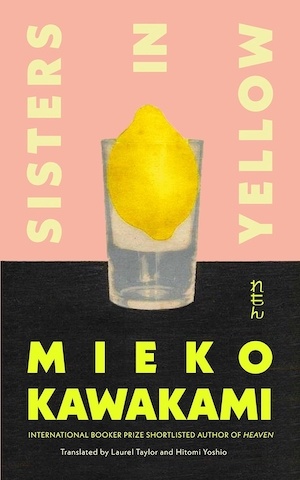
Translated by Laurel Taylor and Hitomi Yoshio — There has been a small but rich vein of Japanese crime fiction translated into English for decades but it has grown in popularity recently. Some examples reflect classic the Golden Age of mystery reimagined for a Japanese audience but there has also been a more radical and original form of Japanese crime fiction since the 1950s, such as Sisters in Yellow by Mieko Kawakami. It’s a drama about friendship, betrayal, coming of age and survival.
It comes as a shock when Hana, a woman in her late 30s, finds details of a court case online which reignites a memory of the past. The defendant is an old friend, Kimiko Yoshikawa, a name she never thought she would forget. But she has clearly buried it in the past, suppressing memories of things that happened 20 years ago in the late 1990s. Unemployed 60-year-old Kimiko, a Shinjuku resident, is charged with kidnapping, blackmail and battery related to the abuse of a woman in her 20s from I Chikawa, in western Chiba.
This is 2020, COVID and lockdown are making everyone’s life difficult and it has affected the courts too. Hana can’t find the outcome of the case but she’s worried it will rake up the past. There is no indication of what happened to Kimiko. Digging out an old phone book, Hana calls an old acquaintance from that time, Ran Kato. Disturbed to be contacted, Ran finally agrees to meet with Hana but only to tell her to forget the past, Kimiko’s case does not concern them. The past will remain hidden if left alone.
We dial back 20 years and 15-year-old Hana meets Kimiko. The woman buys her a soda in the street and they become friends. Kimiko is there when her mother, an alcoholic more often found in dive bars, is not. Her father’s long gone and she lives in a small flat in a rundown district.
Hana wants to make money to leave the poverty and squalor behind so when Kimiko suggests opening a bar she agrees to help. They work hard to establish Lemon in a run-down apartment block. Hana is obsessed with feng shui and yellow stands for wealth. The men come, the bar is a success, the tips are good. Kimiko introduces Hana to Yoeongsu, a shady businessman.
The ‘sisters’, as they become known, are joined by Ran Kato, a calming influence and Momoko, a run-away rich girl. These are tough times economically and the bar is involved in a credit card scam, there’s a fire and a girl goes missing. The world becomes darker, Hana changes, the world is seen for its cynical reality.
This is a slow build and the narrative has a steady pace for most of the novel, which runs to over 400 pages. It’s a rite of passage for Hana, trying to navigate the cruel, dog-eat-dog adult world. It’s about the friendship between Hana and Kimiko. However skewed, the relationship is real and it’s about trust, manipulation, self-interest and betrayal and how people change when their survival is on the line.
Sisters in Yellow is a dark and suspenseful tale, compelling, it induces a sense of dread over what will happen. There is no simple murder to pin the narrative on, this is about self preservation and it comes at a cost, a degradation of values and humanity and yet it’s very human to be fallible.
Author Meiko Kawakami became a New York Times Bestseller with Breast and Eggs in 2020. She is currently one of Japan’s most popular authors and this novel won the Yomiuri Prize for Literature. I admired its ambition more than I loved it. It is a little too long and the narrative could have been sharper, more focused. However, original authors exploring young, marginalised women are to be encouraged this novel offers a thought provoking portrait of modern Japan.
Click here for more Japanese crime fiction.
Picador
Print/Kindle/iBook
£8.99
CFL Rating: 4 Stars






I have to say I’m surprised the publisher tried to categorise this as crime fiction, as it doesn’t feel at all like that – not even very noir. I liked it, but it was slightly baggy, perhaps because the author published it in serialised form first.