

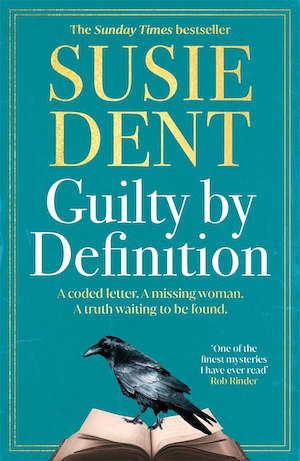
Word-lovers, rejoice! Susie Dent’s debut murder mystery, Guilty by Definition, thrusts a cold case right into the middle of a group of lexicographers, working in the Oxford offices of the Clarendon English Dictionary. The fictional organisation is no doubt a stand-in for the OED.
The story’s protagonist, Martha Thornhill, is in her early 30s. She was appointed senior editor at the CED only six months before the novel begins and oversees three staff: Alex, a woman in her 50s; Safiya ‘Safi’ Idowu, young and brilliant; and Simon, a middle-aged man who’d wanted Martha’s job but is bravely semi-hiding his resentment. Martha’s mother has died, and she lives with her father, Gabriel, a retired university professor. Her older sister Charlotte – or Charlie – had worked at the dictionary before she disappeared without a trace 10 years earlier.
Charlie’s mysterious fate is relevant from the outset. A ‘Dear Editors’ letter is sent to the CED office, stuffed with Shakespeare quotes and allusions. It seems to suggest that the missing Charlie was murdered, and that the sender knows who did it and why.
The CED staff’s facility with wordplay helps them decode the clues in their anonymous correspondent’s communications, which keep arriving – at the office, at their homes and in the post of various other people connected to the dictionary. But, who’s sending these messages, and what do they really know? While it’s painful to think Charlie may have been murdered, it’s also painful to not know what happened to her.
The letters and postcards have a faintly menacing tone, and Martha shares them with the police. A young detective named Oliver Caldwell takes an interest, though Martha cannot stop herself from remembering that in Old English his name means ‘chill spring.’ Caldwell perceives a possible link between the letters and the true crime mania. Charlie’s case would be an ideal topic. Despite his interest and the possibility that the deluge of missives may reflect someone’s real knowledge, Martha clings to her hope that Charlie is merely missing.
The letters hint that Charlie had made a major discovery – one that would rock the lexicographical world by throwing previous assumptions about the origins of a great many words into doubt. Careers might be jeopardised. But is that something worth killing over?
Given the CED’s reputation for diligence, the staff pursue the clues, despite their baffling nature. They learn quite a lot about Charlie that they hadn’t known. She was underhanded with her part-time employer, a book-seller. Her recent breakup with her boyfriend left bad feelings. She rubbed a great many people the wrong way, including CED staff at the time.
What I like most about the story is the way they unravel the clues, putting their exquisitely particular word-sense into play. Martha’s own decision making and preoccupations aren’t always entirely clear, which makes it more difficult to establish an emotional connection with her. It’s as if the intellectual side of the story, that is, the puzzle-solving side, was so engaging to me, it dominated my responses.
The Oxonian milieu is described in convincing detail and relationships among the CED colleagues are also quite believable. Their foray into detection is naturally a bit bumbling, but they are knowledgeable and clever. Martha has a lot to work through, prodded by the tantalising puzzles the mysterious letter-writer lays in front of her and the ghost of Charlie, which she sees around every Oxford corner. Delightful fun!
Tempting as it may have been be to try some witty wordplay in the first sentence of this review, Dent beat me to it with the clever archaicisms at the head of each of the book’s short chapters, and with the staff’s occasional resurrection of favourite odd terms, their origins and their cognates, many of which have to do with excessive drinking.
My favourite of these lexicographic digressions occurs in a discussion about how German, with its tendency to create new words by assembling existing ones, has a word for nearly everything. The example is verschlimmbesserung – an attempted improvement that ends up making things worse. Any of us who has ventured into household repair projects has acquaintance with the concept, even if we didn’t know the precise German word for it!
You might like Anthony Horowitz’s The Word is Murder or Mick Herron’s new Clown Town.
Zaffre
Print
£6.00
CFL Rating: 5 Stars