

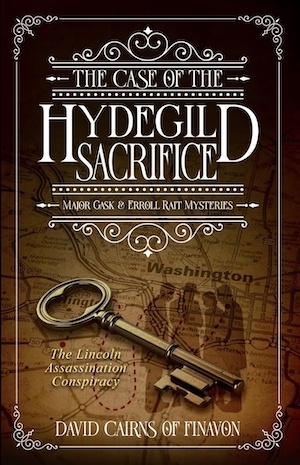
The Case of the Hydegild Sacrifice takes a pivotal event from US history – the assassination of Abraham Lincoln – and reimagines it as fertile ground for mystery, doubt and moral uncertainty. In so doing, David Cairns delivers a novel that is as much about the instability of truth as it is about solving a crime.
This fourth instalment in the Major Findo Gask and Erroll Rait series transports the detectives from their current Edinburgh base and attempts to unmask a would-be assassin to the volatile landscape of the United States in 1865. The country they find themselves in is fractured, plagued by suspicion and still reeling from the Civil War.
While notionally tasked by erstwhile employer Blyth & Cunningham with sounding out government sources about securing engineering contracts to help rebuild the country, Gask and Rait are quickly recruited by female Pinkerton agents Mrs Lewis and Mrs Warne to investigate rumours of a plot to kidnap President Lincoln.
In contrast to the grand scope of the conspiracy and the potential impacts on the world stage, at the heart of The Case of the Hydegild Sacrifice lies the partnership between Gask and Rait, a pairing that consciously echoes the traditions of classic detective fiction – like Holmes and Watson, or Poirot and Hastings – while maintaining a distinct identity for the duo.
Gask, who acts as narrator, is thoughtful, observant and occasionally awkward – qualities that lend him both credibility and charm. Rait provides a counterbalance, grounding the investigation with pragmatism and dry wit. Their dynamic is a convincing one, emphasising the humanity of events amid larger political and historical concerns.
As part of an ongoing series, the book benefits from this established relationship between the detectives. While it can be read as a standalone, there is a sense that Gask and Rait’s history adds depth to their interactions. Their familiarity leads to plenty of in-jokes and references to previous cases, which Cairns addresses in footnotes.
Aside from the fondness for footnotes, Cairns leans heavily into the conventions of historical mysteries, taking full advantage of the genre’s possibilities. The central premise an investigation into the hidden truths surrounding Lincoln’s assassination – allows the story to operate on two levels.
On the one hand, it has the hallmarks of a traditional whodunnit: clues, disguises, shadowy figures and a steadily tightening web of intrigue. On the other, it engages with the ambiguities of recorded history, questioning whether any version of events can ever truly be considered complete or reliable.
This duality is reinforced by the concept of the ‘hydegild’, an archaic idea whereby punishment is transferred from the guilty party to a substitute. Cairns uses this notion not merely as a historical curiosity but as a lens through which to examine justice in the aftermath of national trauma.
The suggestion that blame might be misplaced – or deliberately redirected – runs through the story, generating a lingering sense of unease. It is here that The Case of the Hydegild Sacrifice moves beyond straightforward entertainment and begins to probe more complex ethical territory.
The historical detail is both a strength and a stumbling block. Cairns has clearly immersed himself in the period, weaving real locations, people and events into the fabric of the story. From Edinburgh to New York to Washington, DC, the settings are vividly realised, and the depiction of post-war America is particularly effective in conveying a society on edge.
There are moments when this research comes close to overwhelming the narrative, particularly when explanatory passages slow the pace. However, the historical immersion is undoubtedly strong, and Cairns generally succeeds in integrating background detail without losing sight of the story’s forward momentum.
In particular, the way Gask and Rait are drawn into the orbit of the Pinkerton National Detective Agency allows Cairns to integrate valuable period details into the unfolding conspiracy. While the Pinkertons in general are no strangers to historical fiction, female operatives such as Kate Warne have received considerably less coverage.
Relatedly, the dialogue has a period tone, although the narration remains clear and direct. There are occasional touches of humour, often arising from Rait’s perspective, which help to offset the darker elements of the story. This balance between lightness and gravity is carefully maintained, ensuring that the story never becomes overly sombre despite its subject matter.
The pacing is uneven in places, particularly during the early stages, but the story ultimately finds its rhythm. Once the central mystery is fully set in motion, Gask’s narrative becomes increasingly engaging. Cairns demonstrates a clear understanding of suspense, withholding information and using shifting perspectives to maintain intrigue.
Perhaps the most innovative aspect of the story is Cairns’ willingness to challenge received wisdom. By revisiting a well-known historical event and offering alternative interpretations, he invites reconsideration of what is ‘known’. Rather than revisionism for its own sake, the story offers an exploration of the uncertainties within any historical record.
Still, The Case of the Hydegild Sacrifice remains firmly rooted in the traditions of popular historical fiction. It offers adventure, intrigue and a strong central partnership, all set against a richly detailed backdrop. It is both an engaging mystery and a meditation on the nature of truth, anchored by a central puzzle that has persisted for over a century.
For a different take on the assassination of Abraham Lincoln, try The Blue and the Grey by MJ Trow.
Finavon Press
Kindle/Print
£2.27
CFL Rating: 4 Stars