

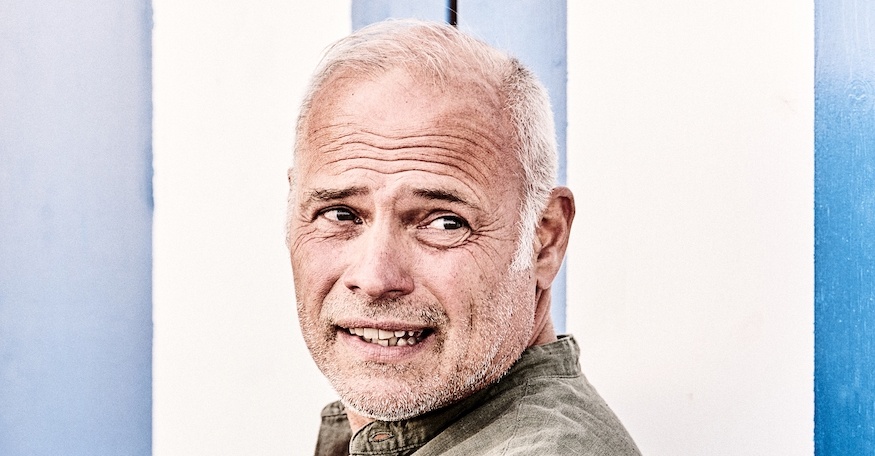
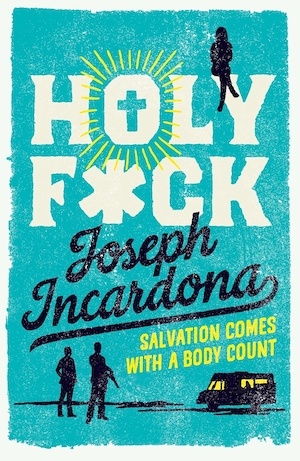
Based in Geneva, Switzerland, Joseph Incardona doesn’t consider himself to be a crime author. However, his first book to appear in English will certainly grab the attention of crime fiction lovers, not least because of its title. Holy F*ck is all about attempts to commit a crime that’s as unique as the immaculate conception. Once we learned of the concept behind the novel, which was originally published in French, we had to sit down with him to find out more.
Down in the American state of Georgia, a saint has appeared among the people. She can cure the ill and diseased, and take away their suffering. More than that, she does it by sleeping with them. Yes, Stella is a prostitute and when the Vatican learn of her their delight soon turns to disdain. So, what better way to round off Stella’s saintly story than to martyr her? The pontiff’s underlings turn to a very unusual pair of hitmen who seem rather immaculate themselves, in a sense.
So let’s meet Joseph Incardona, the man behind this intriguing story…
What are crime fiction lovers going to love about Holy F*ck?
What any reader should love in a novel: a good story, pace, emotion, a distinctive personal voice, and themes that make you think about the world around you.
Who is Stella, what was the inspiration behind her and how have you developed her character?
Stella is a young prostitute touched by grace. She has the power to heal and to perform miracles. She is ingenuous, naive – incapable of perceiving evil. But this gift becomes a kind of curse. She is a little like Jean-Baptiste Grenouille in Parick Süskind’s Perfume: a victim of her own singularity. Everyone who wants to be healed wants to see her, to touch her – though she never asked for any of it.
The character took shape as I went along, because I write without a plan: once I set off, I begin to live with my characters, and I become Stella. There is something wonderful about being a novelist – you are like an actor who gets to live several lives in one.
And what about the Bronski twins?
I was the Bronski twins too! I adore them. They are evil incarnate, and yet they have a code – a fierce insistence on a job well done. They are genuinely appalled if someone bungles a killing. Two pure psychopaths who have had so much cosmetic surgery to evade the authorities that they no longer look alike. They are, of course, the engine that drives the story. But unlike those who hired them to make a martyr of Stella, they hide behind no lies, no veneer of morality. In that sense they are utterly sincere – whole, consistent, faithful to their single principle, which is to have none, except that of work done properly. There’s a fine contradiction for you: honest in their madness and their depravity, while the world is more often run by dishonest people who think of themselves as upstanding and moral.
How did you come up with this set-up, which is fraught with all sorts of religious conflicts?
From a single idea: what if a prostitute performed miracles? What if grace were to manifest itself in the very place for which Man was cast out of Paradise – the sin of the flesh? How would the religious authorities deal with that paradox?
I should say that I am myself a Catholic, and as a child I was even an altar boy, serving at Mass! None of this was intended to stir up controversy or to offend anyone’s faith. And indeed, the book caused no such controversy in France or the French-speaking world. At its heart, it is a meditation on tenderness, on self-giving, on generosity, on our relationship to the body… And then there is the figure of the Virgin, who never asked to be the mother of God. At the bottom of it the questions Stella asks herself are those of an ordinary woman overtaken by events – by something so much larger than herself.
Why did you choose Georgia as the setting and what role does the setting play in the novel?
It’s a kind of homage to a writer I deeply admire: Harry Crews. And there are so many others in that world: Flannery O’Connor, Carson McCullers, Erskine Caldwell… More broadly, it is the Deep South where Tim Gautreaux, Jim Thompson, Larry Brown and James Lee Burke have set so many of their novels. A place of poverty, where people are often overlooked – a land of contrasts, of violence, but also, paradoxically, of poetry, legend and lyricism. It is the backdrop of so many genre films too – Leatherface above all – and I’m a devotee of that tradition. There, in that forgotten corner of Georgia, a saint appears; in an unlikely place, pure love is born.
What sort of tone and atmosphere were you aiming for and how have you achieved it?
Something sticky, humid, high-summer. Tennessee Williams territory. A place of poverty, where America is dying – where the myth that has meant so much to us Europeans, that has fired our imaginations for decades, is coming apart. An unsettling landscape, peopled by freaks and the left-behind, the kinds of figures who unsettle gentrified respectability. A place of violence, but also of freedom. Hard, bitter people to whom life has not been generous. That, I think, is where humanity has the most to say.
What are some of the bigger themes you wanted to explore?
Generosity, squandered innocence, the freedom to be oneself in the face of dogma and social convention. The struggle to become who you want to be, rather than who others have decided you should be. It is also a novel about redemption. Father Brown is a former Navy SEAL who has traded his M-16 for a Bible…
Which crime authors or books have influenced or inspired you and why?
Harry Crews, Larry Brown, Dennis Lehane, Steinbeck… But there are so many, and not necessarily crime writers: the Chilean Roberto Bolaño, the Swiss Charles-Ferdinand Ramuz… All the classics… A writer absorbs so many influences that in the end you can’t always tell where things come from. At the moment I am reading Jaws by Peter Benchley – very good, and nothing like Spielberg’s film. Another writer I love for his tone and originality is Mark Haskell Smith. And one shouldn’t forget cinema, television, theatre. Everything feeds the work.
What’s it like seeing your work appear in English for the first time and how are readers responding to the book?
A great joy and a great honour. In France, for instance, around 75 per cent of translated books come from English, while only about 3 per cent travel in the other direction toward the US or UK market. That tells you how hard it is for European writers to reach English-language readers. For that reason, I am especially grateful to François von Hurter of Bitter Lemon Press for publishing me.
Like any writer, I hope the book finds its readers and is appreciated. I’m curious to see how British and American audiences respond. This is why translation matters so much – it builds bridges that might otherwise never exist. I live in Switzerland, a country where four national languages coexist, not counting the immigrant languages that are gaining ground. Translation is part of daily life here; multilingualism is simply a reality. You train your ear, you learn new languages, you expand your creative range.
What’s next for Joseph Incardona?
A novel in progress, a series for Swiss television, and a collaboration on a documentary film. But above all, and always: living life.
Holy F*ck appears in English for the first time on 23 April 2026, published by Bitter Lemon Press. Use the buttons below to order your copy. Main image (c) Chloe Cóhen.