

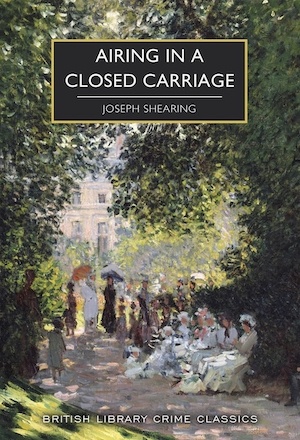
First published in 1943 under the pseudonym Joseph Shearing, Marjorie Bowen’s Airing in a Closed Carriage combines historical fiction, psychological examination and crime writing. Now part of the British Library Crime Classics series, it is a quietly unsettling exploration of suspicion, cruelty and the suffocating weight of expectation.
Inspired by the notorious Florence Maybrick trial, the novel follows an American heiress, May Beale, who marries into an English industrial family, settles in Manchester and finds herself increasingly isolated in an environment that is both alien and hostile. From the outset, there is a sense of imbalance, of a woman misaligned with her surroundings.
May’s marriage is uneasy, her new household is inhospitable and the social world she enters operates according to codes she neither shares nor fully understands. When her increasingly estranged husband, John Tyler, dies under suspicious circumstances, the question of guilt emerges almost inevitably.
What comes across most powerfully is not the mechanics of the alleged crime but the atmosphere in which it unfolds. The story progresses deliberately, allowing tension to build in small, incremental ways. Domestic interactions, social slights and passing remarks accumulate into something heavier, more oppressive.
The early sections are steeped in discomfort: a sense of being watched, judged and quietly undermined. In terms of John’s death, certainty is withheld, and the question of whether May has committed the crime (if there even was one) is unaddressed. This ambiguity is not a puzzle to be solved but a condition to be experienced.
Evidence is presented, but it never gives rise to clarity. Instead, understanding shifts depending on perspective, shaped as much by prejudice and assumption as by fact. Suspicion grows not because of a single decisive moment but because a narrative of guilt begins to take hold and is gradually reinforced by those around May.
Gossip, observation and social bias intertwine until they create an impression that feels incontrovertible, even when it rests on fragile foundations. May’s world is one in which reputation can be constructed and dismantled with alarming ease, and where truth is less influential than the stories people choose to believe.
Class tension runs through the novel. May’s genteel background sets her apart from the family she marries into, and this difference colours every interaction. Her reserve is interpreted as aloofness, her discomfort as disdain. In particular, her foreignness is easily accepted as a sign of moral turpitude.
The household May enters is marked by ambition and a certain coarseness, its values rooted in status and material success rather than refinement. These differences are not merely decorative; they shape the way she is perceived long before any accusation is made. When suspicion arises, it finds fertile ground in the established divisions.
Gender expectations deepen May’s sense of vulnerability. The role of the dutiful wife hovers over the story, defining what is acceptable and what is not. Any deviation, however slight, becomes significant. Behaviour that might otherwise pass unnoticed is scrutinised, interpreted and, ultimately, weaponised.
Meanwhile, the failings of others – particularly those of John Tyler as a husband – are absorbed into the fabric of everyday life, remarked upon but rarely condemned. The imbalance is stark, revealing a social order in which judgement is unevenly distributed and often unforgiving.
This accentuates the undercurrent of menace, most notably in the figure of Richard Tyler, John’s brother. His presence introduces a sharper edge to the already uneasy domestic setting, suggesting that the dangers facing May are not solely abstract or societal. This tension heightens the sense of entrapment facing her.
As events progress, things do not so much spiral out of control as settle into a pattern that feels increasingly difficult to disrupt. Each misunderstanding, each unkind interpretation, contributes to a tightening web of circumstance. The trial feels like a natural culmination of everything that has preceded it.
Moments of cruelty and injustice are presented with a clarity that makes them all the more disquieting, precisely because they are not exaggerated. There is also a subtle thread of irony running through the story, particularly in its portrayal of social respectability. Characters who present themselves as moral arbiters often reveal pettiness, hypocrisy or self-interest.
May’s life is constrained by forces that operate both openly and invisibly. Social codes, personal prejudices and institutional structures combine to create a system in which her agency is severely limited. The tragedy lies not only in what happens but also in the apparent inevitability of it occurring.
Airing in a Closed Carriage presents a quiet, domestic, deeply unsettling mystery rooted in the gradual accumulation of tension and the careful observation of human behaviour. The key takeaway is a lingering unease, a sense of how easily certainty can be manufactured and how difficult it can be to resist.
For more British Library Crime Classics, try Death in High Heels by Christianna Brand and Death in Ambush by Susan Gilruth.
British Library Publishing
Print/Kindle
£9.59
CFL Rating: 5 Stars