

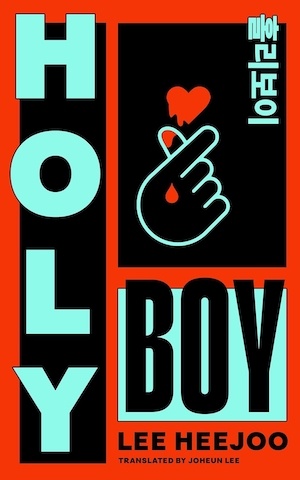
Translated by Joheun Lee — K-pop hysteria is taken to a new extreme in Lee Heejo’s Holy Boy, which is the author’s first novel to appear in English debut. The story is equal parts psychological horror and crime novel, and is set in 1990s South Korea.
Yosep, a 21-year-old K-pop idol, has the world at his feet. His mostly female fans swoon when he says he loves each and every one of them as if they were his own lovers. But fame comes at a price. Yosep wants to escape his public life and has a plan to do so. Unfortunately, his path is derailed by four obsessive women who refuse to share him with the rest of the world. Each believes he is destined to be hers alone.
Ahna, Mihee, Nami and Heeae have hatched what they believe is the perfect plan: they will lie in wait on the road Yosep travels and kidnap him. However, on that particular day, Yosep takes another route. When they eventually find him, he is already unconscious and sitting alone in his vehicle.
When he wakes up, he has no idea where he is or what day it is. Conveniently, he has no recollection of the events that led him there. His rib cage is wrapped in bandages and his legs are tightly splinted like a toy soldier while the women take turns caring for him. According to them, he was involved in a terrible accident; he is currently paralysed and needs time to recover.
However, each woman harbours an ulterior motive. Ahna, in her 40s, craves attention from a younger man out of loneliness and desperation. Mihee is in her 20s and pretty but socially awkward and shy. Nami is a shaman who believes she shares a spiritual connection with Yosep, while Heeae is the only one who can lay a real claim to him: she is his birth mother. It’s a little bit like Annie Wilkes from Misery, times four.
Yosep becomes a mere object in the narrative; we hardly hear his side of the story. Instead, we are presented with the backstories of the women and the circumstances that led them to this bizarre situation. The absurd conditions spin further out of control when they turn against each other, eventually resulting in the discovery of their hideout and two dead bodies.
Do not go into this expecting a traditional, straightforward crime novel. As is sometimes the case with Asian thrillers and horror novels, the style is different and uncomfortable, with a generous serving of weirdness. This adds to the claustrophobic atmosphere and the complete unhinged nature of the four women. The narrative also jumps around in time, which may either confuse you or contribute to the overall feeling of a loss of control.
There is a sense of disconnect between the characters and the reader. They feel two-dimensional, difficult to identify with, and quite unlikable. While this could be intentional, it makes for a less enjoyable reading experience. The author does not shy away from the controversial; featuring graphic and sexual violence, this is not a book for the meek.
Heejo successfully highlights the frenzied cult following and outlandish behaviour of K-pop fans, as well as the objectification of pop stars. Apparently, fans showing up at an idol’s home wanting to move in is not as far-fetched as one might think. Perhaps that is the scariest part of the entire novel.
Also see The Good Son or Perfect Happiness by You-jeong Jeong.
Picador
Paperback
£12.09
CFL Rating: 3 Stars