

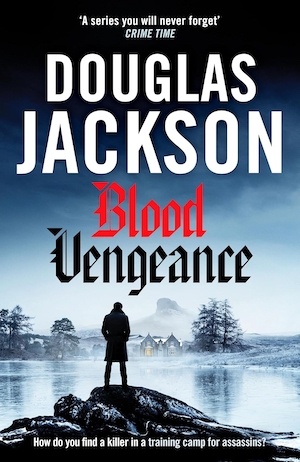
The third of Douglas Jackson’s Warsaw Quartet follows Blood Roses and Blood Sacrifice and sees Polish investigator Jan Kalisz taken from occupied Warsaw and dropped in to northern Scotland at the orders of Winston Churchill himself. Krystina Kowolska, resistance agent and a mionor member of the Polish aristocracy, was murdered in the Special Operations Executive (SOE) training centre at Arisaig as she prepared to return to active duty in her homeland. Following the death of the Polish prime minister in-exile, Churchill can’t afford for her death to further strain relations between the two Allied countries and wants the matter resolved quickly.
A Polish detective is need for political reasons, and Kalisz is an obvious choice. He’s an experienced Kripo investigator who has held onto his job after the German invasion. Unbeknownst to everyone, he is also active in the resistance. There are hints that British high command also want a flexible pragmatist who will come up with the right solution to Kowolska’s death, even if it’s not necessarily the correct one. In this, they may have misjudged Kalisz’s character. Many people would find the pressure of Kalisz’s double life in Warsaw overwhelming, but the quiet, methodical detective possesses a steely determination and a moral code that makes him resistant to outside pressures.
Arisaig is situated in a remote part of the Scottish countryside near the coast. It’s the perfect place for SOE agents, army and navy personnel to train in secret for their missions across Europe. Overseen by a few instructors, its inhabitants are encouraged to secrecy, fraternisation between the different groups is actively discouraged, and the agents don’t even reveal their true names to one another. The missions are dangerous and so the training is too. Live rounds and explosives are used, and accidents, sometimes fatal, are seen as an occupational hazard. Under the circumstances, it’s not surprising that the arrival of Kalisz and his SOE assistant, Lucy Deveraux, is unwelcome. It doesn’t take long for the astute Kalisz to realise that any assistance in his investigation will be given grudgingly, if at all.
Kowolska was discovered hanging from a tree. Close by lay the body of a French-Canadian officer, Jean-Marc Fontaine, shot in the head. Fontaine was said to have been infatuated with the haughty Kowolska who had rebuffed his advances. If Kalisz would just confirm that this was a tragic murder-suicide, top brass would be very grateful. A win-win for everyone; Kaliscz would be able to return to Warsaw and his family before the Gestapo realise he has even left the country, Arisaig’s integrity could be safeguarded, and the agents could continue their preparation for their vital missions.
But the crime scene is all wrong. Despite the setup, the deaths could not possibly have happened as suggested, and Kalisz has no compunction about speaking up. A proper investigation will be necessary.
Perhaps it’s the author’s background in journalism that allows him to recreate Arisaig so vividly. The rugged landscape, the short days and long, dark winter nights, and the all-pervading sense of secrecy conspire to create a claustrophobic atmosphere and a palpable sense of peril for Kalisz and Deveraux. A single misstep, poking their noses in to the wrong business – what else are investigators supposed to do – could result in their deaths. They and we know that their demise could easily be painted as just one more unfortunate accident. The light shone on this secret history of World War II is the highlight of the book.
Their are plenty of suspects for Kalisz and Deveraux to eliminate. Kowolska was a complicated lady, desired but not liked, and her history of capture and escape made many of the students suspicious that she was a traitor. She was profoundly antisemitic. Readers for whom the solving of the murder is an important part of the enjoyment of crime fiction might feel slightly cheated by the resolution of the case. I did feel it was slightly anticlimactic.
Alongside their investigation, we discover more about Operation Bishop – Kowolska’s last mission which led to her capture by the Gestapo and subsequent rescue, and the life back in Warsaw of Kalisz’s family. The latter features a chilling cameo by Klaus Barbie, the infamous Butcher of Lyon.
Coming in to a series on the third book can sometimes be less than ideal, but Blood Vengeance works well as a standalone historical mystery. Indeed, I expect to find myself returning to the series from the beginning. The hardcover is already out and the paperback is released on 7 February 2026.
Also see the Bernie Gunther series by Philip Kerr.
Canelo
Print/Kindle/iBook
£0.99
CFL Rating: 3 Stars