

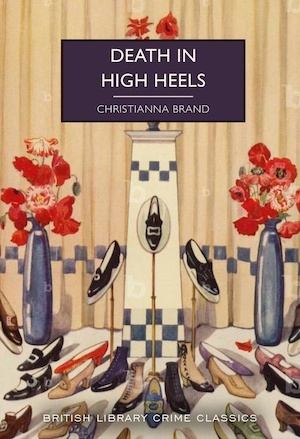
A debut back in 1941, Christianna Brand’s Death in High Heels opens with the light, breezy tone of a comedy set in the world of retail fashion. Something akin to Are You Being Served? or Mr Selfridge perhaps. However, beneath its witty surface lies a sharp study of gender, class and social constraint. And of murder too, of course.
Set in Christophe et Cie, an exclusive London dress shop, events begin amid satin and silk, a microcosm of elegance and envy, but build to reveal both a fiendish murder mystery and the tangled web of women’s lives in a pre-war society still rigidly bound by class and gender expectations.
Indeed, what appears to be a genteel Regent Street setting for fittings, gossip and feminine grace soon becomes the stage for a biting commentary on how women survive – and sometimes turn against one another – in a world that continues to offer them limited avenues of power.
All the staples of a classic British whodunnit are present. There are romantic entanglements due to the manager’s eye for the ladies and an employee’s pursuit of a divorce. There are rivalries over who will be promoted to run the new shop in Deauville. And there are the good old-fashioned resentments of people forced to spend considerable time together.
Poised and ambitious, Miss Doon is in a relationship with the manager and in the running for the promotion when she dies after eating a poisoned lunch. Suspicion falls on the small group of employees. This closed circle of suspects comprises only 11 individuals, and two to them had recently purchased oxalic acid, allegedly to clean a hat.
Inspector Charlesworth, the archetypal incompetent young detective, is sent to investigate – provided he can avoid falling in love with the suspects for long enough to put the clues togethers – aided by Sergeant Bedd. However, the real intrigue unfolds within the enclosed community of the shop.
In constructing and deconstructing the crime, Brand focuses on the social and psychological realities of working women in the early 1940s. To accomplish this, she diverges from the Golden Age tradition and situates the drama in a recognisably ordinary workplace: a site of economic necessity, roles determined by class and constant social negotiation.
The shop is a glamorous façade and a site of quiet oppression. The employees at Christophe’s are drawn from various backgrounds: secretaries, saleswomen, models and seamstresses, each trying to navigate an environment defined by appearances. Beauty, taste and refinement are commodities, and women’s survival depends on their ability to embody them.
Yet this glamour is precarious. The women labour to sell luxury they cannot afford, catering to an elite clientele that treats them with condescension. The setting mirrors the broader contradictions of women’s roles in early 20th century Britain – they are granted visibility but not power, valued for their appearance rather than their agency.
The employees of the shop, bound together by their shared ambition and insecurity, enact a hierarchy that mirrors the patriarchal society surrounding them. Miss Doon’s rise within Christophe’s threatens others precisely because advancement for women is so rare. Success must often come at another’s expense, a truth that gives the novel its psychological edge.
Brand’s portrayal of female relationships is nuanced, far from the sentimental sisterhood sometimes found in contemporary fiction. Her women are clever, ironic, defensive and sometimes cruel, but they are always vividly human. They gossip and scheme, but their pettiness is born of frustration rather than innate malice.
The confined space of the shop becomes a stage for observing how women manage reputation, rivalry and desire under pressure. Each character’s manner of self-presentation becomes a survival tactic. In this way, Brand shows remarkable modernity: her women are aware of the roles they must perform, and their awareness becomes a form of critique.
Social class, too, is a persistent undercurrent. Though Death in High Heels unfolds within a dress shop that caters to the wealthy, the women who work there occupy a precarious position – close enough to luxury to see it, but never to own it. Brand captures this tension with humour and acuity.
The women’s discussions about clients’ clothes and social lives reflect both fascination and resentment. They are cultural intermediaries, responsible for maintaining the illusion of upper-class perfection while remaining excluded from it. Class boundaries remain rigid despite the upheavals of World War I and the gradual expansion of women’s employment.
The men in Death in High Heels are peripheral yet significant, functioning as reminders of the gender dynamics that structure the women’s world. Frank Bevan, the proprietor and manager of the shop, is a figure of authority but also of detachment. The women do the emotional and practical labour that sustains his business’s reputation.
Inspector Charlesworth, though generally sympathetic, also views the emotional intensity of the shop with condescension. His investigation exposes not only the mechanics of the murder but also the social tensions underlying it: jealousy, economic dependency and the limited mobility available to women.
Brand’s tone oscillates between satire and empathy. Her sharp ear for dialogue captures the rhythms of shop floor conversation – quick, witty, defensive – and her eye for detail lingers on subtle signs: the careful application of lipstick, the deliberate adjustment of a hat, the exchange of glances that carries both alliance and betrayal.
She also captures the social unease of the moment. Published during the early years of World War II, Death in High Heels reveals a society on the brink of transformation. The shop’s hierarchical world, with its strict rules of decorum and its obsession with appearance, is already starting to feel outdated.
Still, the murder itself feels very much of its time. Oxalic acid can be easily purchased from the local chemist without the need to sign the poisons books, and the many reasons for owning such strong poison all seem socially acceptable. Plus, its toxicity fits the toxic environment in which the killing occurs.
But speaking of things being of their time… when viewed through a modern lens, Death in High Heels arguably has more unpalatable aspects than the bulk of Golden Age mysteries. The sexism and homophobia are overt, and Christianna Brand’s general descriptive tone is incredibly mean-spirited. Such aspects do detract from the solving of the crime.
Death in High Heels is certainly an entertaining mystery, but more than that, it is an example of incisive social commentary. The murder may take place in the confines of a shop, but its implications stretch across the social spectrum. Brand’s insight into a changing world gives her novel enduring bite.
For more British Library Crime Classics, try Death in Ambush by Susan Gilruth and Twice Around the Clock by Billie Houston.
British Library Publishing
Print/Kindle
£2.99
CFL Rating: 4 Stars