

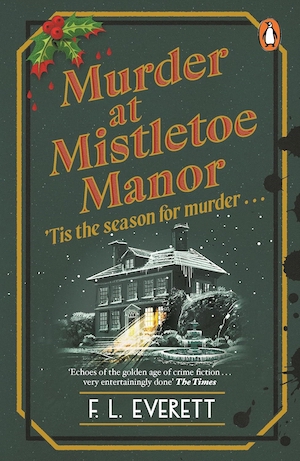
FL Everett’s Murder at Mistletoe Manor is a snowbound murder mystery that manages to be genuinely festive and genuinely chilling. A closed-circle whodunnit, it pays homage to Agatha Christie’s And Then There Were None and other Golden Age mysteries, but it does so with a modern sensibility and a wry sense of humour.
It’s four days before Christmas when journalist Nick Caldwell, desperate to get home to London for his baby daughter’s first holiday, takes a wrong turn in bad weather on the Yorkshire Moors and ends up seeking shelter at Mistletoe Manor, a genteel hotel hosting a small group of guests for the festive season.
The snow continues to fall, the Wi-Fi packs in, the mobiles lose signal and, soon, the storm seals the hotel off from the outside world. When one of the guests is found dead the following morning, the isolation turns sinister. With no help coming, Nick – an amateur sleuth with more curiosity than skill – finds himself leading a desperate investigation.
The setup may sound familiar, but Everett’s execution is deft. Rather than merely echoing Christie, she reinvigorates the stranded guests trope through the characters’ distinct personalities and contemporary concerns. The 12 people stuck in the hotel are sharply drawn individuals, each with a voice, a secret and a slightly ridiculous quirk.
There’s a new age spiritualist who communes with her emotional support dog, a pompous businessman whose confidence masks insecurity, an elderly couple with an unexpectedly dark past, an obsequious hotel manager and a child whose presence adds a faintly unnerving quality to proceedings. Even the hotel cat manages to contribute both humour and hints.
Nick makes for an endearingly flawed detective. Everett wisely avoids the trope of the gifted amateur sleuth who outshines the police. Instead, Nick’s efforts to uncover the truth are clumsy, impulsive and often misguided. He jumps to conclusions, accuses the wrong people and generally makes a mess of things.
Yet his doggedness and decency anchor the story. His inner monologue – equal parts anxiety and exasperation – provides comic relief without undermining the tension. He’s the kind of character who has the potential to irritate, but Everett ensures that he remains relatable as he stumbles from one wrong guess to another.
Mistletoe Manor is the perfect setting for his investigation. Everett describes the hotel in rich detail: the creak of the staircases, the flickering lights on the Christmas tree, the smell of mulled wine mingling with cold air and fear. The snow storm outside enhances the claustrophobia within, turning the hotel into both a sanctuary and a trap.
The story gets off to a fairly slow start: Nick’s drive through worsening weather, the relief of finding shelter, the introduction of fellow guests. Once the first murder occurs, however, the tempo quickens. Paranoia sets in fast, and the characters begin to alternate between collective suspicion and private introspection.
Everett resists the urge to rely on melodrama, instead letting the sense of dread build through glances, overheard conversations and the quiet unease of being trapped with strangers. By the time the second murder occurs, the characters’ anxiety and feeling of confinement are palpable.
Still, Murder at Mistletoe Manor maintains a delicate balance between cosy and unsettling. Everett’s humour is dry and self-aware, often playing off the absurdity of the situation: nervy strangers trying to maintain civility while snowed in with a killer, people discussing motives for murder over mince pies, a cat casually wandering through scenes of chaos.
Yet beneath the comedy lies genuine menace. The accumulating deaths are shocking not for their gore (Everett keeps the violence off the page) but for the psychological tension they create. As it becomes increasingly unlikely they’ll all live to see Christmas Day, everyone becomes both suspect and potential victim.
As for determining which is which, the mystery is both fair and cleverly constructed. Everett lays out clues with care, hiding them in dialogue and small gestures. There are red herrings aplenty – Nick himself becomes one, thanks to his overzealous investigations – but when the truth finally emerges, it feels both surprising and inevitable.
The dialogue sparkles with personality, often punctuated by gentle digs at modern life: the reliance on technology, the cult of self-improvement and the peculiar way people try to remain calm in a crisis. Everett understands that the best cosy mysteries comfort not because they deny death but because they reaffirm the value of decency in the face of danger.
If there’s a minor flaw, it’s that Nick’s constant theorising occasionally slows the pace. His tendency to suspect everyone, sometimes twice, stretches a few scenes overly much. Yet Murder at Mistletoe Manor is less about the brilliance of deduction than about the messy, fearful process of trying to impose order when the world has stopped making sense.
It succeeds because Everett understands what is required from a Christmassy murder mystery: a cast of colourful characters, a setting that’s both comforting and confining, a plot that keeps the guesses coming and a resolution that restores order without denying the darkness that came before.
For more festive murder mysteries, try The Christmas Clue by Nicola Upson and Miss Winter in the Library with a Knife by Martin Edwards.
Penguin
Print/Kindle/iBook
£4.99
CFL Rating: 4 Stars