


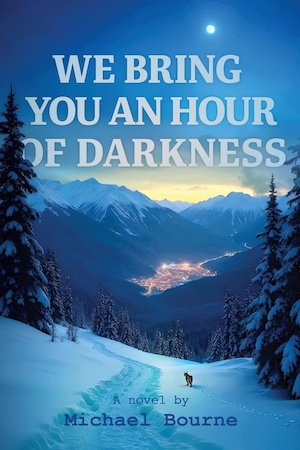
As we watch helplessly while the world around us slowly melts, dries up and goes desiccated, it’s no surprise that some crime authors are taking environmental issues seriously. Protecting the natural world in the face of human development has been on the mind of Vancouver-based author Michael Bourne for some time, and on 14 October 2025 his publisher, DoppelHouse Press, will be releasing Michael’s new novel, We Bring You an Hour of Darkness. If you’re enjoying the rising tide of eco-thrillers, then it needs to go on your TBR list straight away.
The book is set in the fictional Colorado skiing town of Franklin, and set in the early 1990s. A group of eco-terrorists is hitting construction projects that threaten the habitat of a species of lynx, which is going extinct in the US. An FBI task force is on the case. Meanwhile, local journalist Tish Threadgill and her colleagues are investigating the story as their publication faces increasing financial pressure, with that new fangled thing the World Wide Web just around the corner. And, this is a devious thriller, so there could well be something else going on in Franklin for them to uncover…
Originally from the San Francisco area, and having worked on small-town newspapers in Colorado and California, Michael Bourne is writing about a life he knows well, and topics that interest him. We decided to find out more about the author and his latest novel.
What are crime fiction lovers going to love about We Bring You an Hour of Darkness?
I wrote We Bring You an Hour of Darkness to be the kind of thriller I’d like to read myself: smart, taut, with a twisty plot and strong writing. I like to say that We Bring You an Hour of Darkness is a detective novel in which the detectives are reporters at a small-town newspaper.
Tell us about your protagonist, Tish Threadgill. Who or what inspired this character, and how have you developed her?
Tish is the editor of the Franklin Flyer and she’s still in mourning for her brother, who founded and ran the paper before his suicide five years before the start of the novel. Tish was a #girlboss decades before hashtags were invented. She edits the paper and is probably its best reporter. Tish is a reporter to her fingertips. She believes passionately in the journalist’s creed to comfort the afflicted and afflict the comfortable. She has worked seven days a week for years, killing any chance at having a love life, until midway through the book when she meets a guy she didn’t see coming.
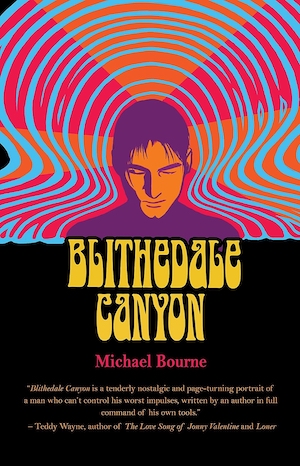
After my first novel Blithedale Canyon, which features a deeply screwed up guy in his 20s, my wife said I needed to write a book that starred a woman she could cheer for. So I wrote this book for her. In some ways, Tish is her. Tish is all the strong women in my life – my wife, my mother, my sister, and on and on. These are women who have spent their entire professional lives being underestimated and have turned that into a superpower.
Who or what is she up against?
The obvious answer is that she’s up against the mastermind of the Jack Frost Collective, the eco-terror group menacing Franklin, Colorado. Tish and her band of fledgling reporters have to solve the mystery behind the attacks before someone gets killed. That’s the core drama of the novel. Deeper down, though, Tish and her reporters are up against a cabal of local politicians and businesspeople bent on turning sleepy Franklin into a massive ski resort. Of the two, the local politicians and businesspeople are the more dangerous foe.
Who are some of the other interesting characters we’ll meet in and around Franklin?
Here I’ve got to mention Bill Blanning, author of the 1970s cult classic novel Screwdriver in the Gears, which the Jack Frost gang are using as their Bible. Blanning wrote three books that changed how Americans saw the West, but he hasn’t written a book in more than 20 years and he spends his days drunk, shooting out the lightbulbs in his own house. But, as the reader learns late in the book, he holds a secret about the identity of the Jack Frost gang.
Blanning comes from many sources, but I got to know Hunter S Thompson a little when I was a reporter in Aspen, and a little of Hunter – and Hunter’s legend – seeped into Bill Blanning.
How does the town of Franklin play into your story?
I was a reporter for the Aspen Daily News in Aspen, Colorado, from 1989 to 1992. The Franklin Flyer isn’t the Daily News any more than Aspen is Franklin, Colorado, but obviously it gives me a leg up on knowing how a small daily newspaper in a ski town works.
Even back then, when I hadn’t written a word of fiction, I sensed that a ski town newspaper would be a great world to set a novel in. I loved that little paper, and I wanted to give readers what it was like working at one, the camaraderie, the humor, the cynicism, as well as the reporter’s abiding idealism. I loved being a reporter, too, which was more than a little like being a detective. You spend all day asking people questions they don’t want asked and you sort through what they say to figure how what’s true and what isn’t.
Why did you choose to set the book in the early 1990s?
1993 was the last year a print newspaper could be unaffected by the digital revolution. It was such a different world. No smartphones, no Google, no YouTube, no social media. Especially in a ski town, which is cut off from the world by mountains and snowpack, the local newspaper was the only game in town. When I used to go out for breakfast in Aspen, literally every person in the restaurant would be reading that morning’s paper. The person behind the counter would be reading it, too. You could watch people read your words in real time. It was something else.
What are some of the bigger themes you wanted to explore?
I got very interested in the question of whether it’s ever justified for a protest movement to become violent. In the 1990s, frustration with the lack of response to traditional environmental protests led to the formation of violent activist groups like the Earth Liberation Front, which fire-bombed some ski lifts and an on-mountain restaurant in Vail to protest the opening of a new ski area. So, where is the line? Is it ethical to destroy property and even potentially to harm people if the goal is to stop environmental destruction? My view is that violence is counter-productive, in that it turns your own supporters against you, but I understand the frustration. If nobody’s listening, sometimes you have to raise the stakes.
We’re seeing lots of eco-thrillers now – how does We Bring You an Hour of Darkness fit into the genre, or stand out from it?
Yeah, it’s cool to see so many other good books zeroing in on this theme. We Bring You an Hour of Darkness is much more of a twisty mystery. Most of the eco-terror books I’ve read, like Rachel Kushner’s Creation Lake and Eleanor Catton’s Birnam Wood, put you inside the mind of activists. That’s cool, and I do some of it in my book. From the start, though, I wanted to tell the story of the destruction of wilderness and delve into the ethics of eco-terrorism, but I wanted to do it in a way that would be engrossing for a reader who doesn’t really care about those issues.
Which authors and/or books have inspired you, across crime fiction, and why?
Oh, my God, so many. I read a lot of crime fiction, though I lean toward the more literary end of the genre. I’m a Tana French completist, and I’m a big fan of Liz Moore, Dennis Lehane, Adrian McKinty and Scott Turow.
My biggest find recently, though, has been the work of Michael Connelly. Connelly was a crime reporter first, and it shows. He understands the LAPD and the justice system in LA at profound level. The plots are great, but I’m much more interested in how he drops these larger-than-life characters like Harry Bosch and Mickey Haller into these fully developed worlds. And he turns out a book a year. The guy is just astonishingly good.
What’s next for Michael Bourne and what’s next for Tish Threadgill?
I’m still writing about domestic terrorists, but this time I’ve moved the scene to Seattle and dialed back the clock of history to the late 1960s. My next book is about a small collective of anti-war radicals who have declared war on America. Many of the same questions animate this book, but the tone and plot is quite different.
As for Tish, I wouldn’t rule out a return engagement. A lot of interesting things have happened to newspapers since 1993, and it would be interesting to see how she navigates the onset of the digital revolution.
And what about the lynx?
The story of the lynx is real. Lynx are fairly common in the boreal forests of Canada, but they had gone all but extinct in the United States. In the years I’m writing about, some wilderness experts thought there were a few lynx chasing snowshoe hare in Colorado, but most thought the species was extinct below the 49th parallel. In 1999, scientists re-introduced the lynx in Colorado. The program is considered a success, but the cats are still endangered in the US.
We Bring You an Hour of Darkness is released on 14 October 2025. Use our buttons below to order your copy.