

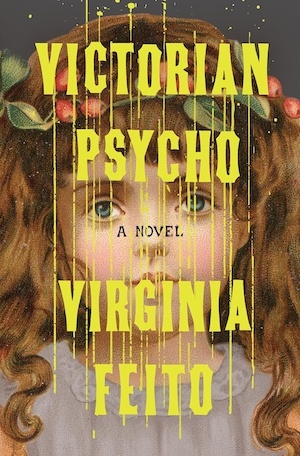
Virginia Feito’s new gothic thriller, Victorian Psycho, has attracted the attention of readers and commentators not only for its originality, but for its in-your-face macabre violence. It’s graphic. It’s bloody. And in this book, the first-person narrator is the serial killer. She doesn’t murder at a discreet distance, either. No poison here. When toward the end of this 190-page book she tells you she’s holding a cleaver, well, you know . . .
It’s also worth saying that much of it is highly comic, poking fun at the aristocracy and its Victorian-era pretensions. The heroine, Winifred Notty (which I invariably read as ‘naughty’) is posing as a governess for the two children of the Pound family: Drusilla, an angsty teenager, and the young heir, William, insufferably puffed up with his future importance.
Their mother is a faded woman, imprisoned by the constraints of her social situation and unable to think beyond them. Though she senses something off about Miss Notty, she grabs hold of the wrong end of the stick when she believes the governess is trying to seduce her husband. Mr Pound may actually be interested in being seduced. But Miss Notty has something else entirely in her plans.
The servants tend to avoid her. In this book, they are obviously an oppressed class. The stingy Christmas presents the Pounds have set aside for them are just sad. Though Miss Notty is almost a servant, she isn’t interested in them and thinks nothing of dispatching one or two of them as she sees fit. For the most part, they are just part of the scenery. And lonely scenery it is, out in the country. She also disdains the Pounds’s friends and family when they visit, picking up on their least attractive, sometimes comical attributes. While they see Miss Notty as a quiet woman relegated to the backdrop, she sees them as fools and posers.
You gradually assemble a sort of understanding of the upbringing of Winifred – or ‘Fred,’ as she has the children call her. She was illegitimate; her father refused to marry her mother, and she married a vicar in a small village. Perceptively, he grew to think of his stepdaughter as the incarnation of evil. She was sent to a girls’ school, but after The Incident – which I’ll leave you to discover on your own – she was returned home; shocking things were found in her room at the parsonage. And it’s true; Winifred herself refers to the darkness within her, struggling to emerge.
It certainly isn’t a coincidence that so many scenes in the story take place around the dining table, where Miss Notty is allowed to eat with the odious Mr and Mrs Pound. Food and eating are a theme throughout the story, and Winifred describes many of the dishes in lascivious detail. But then she has something of an oral fixation – prone to biting or licking or sucking on various objects and people.
I came to think of this story as akin to a gruesome fairy tale – a truly Grimm one – in which all sorts of outlandish and grotesque occurrences are possible. You must decide for yourself how much is literally true and how much is in Miss Notty’s peculiar mind.
Although it qualifies as a thriller, the story isn’t actually suspenseful. Winifred tells you at the outset that the household is doomed. On the autumn day a phaeton delivers her for the first time to Ensor House, which Feito named for the surrealist painter James Ensor, she tells you that “in three months, everyone in this house will be dead.” You’re only waiting for the axe to fall. And these tragedies aren’t as horrible as they may sound, since you probably won’t develop much sympathy for any of her victims.
Spanish native Virginia Feito was educated in England and is the author of the popular psychological thriller Mrs March. Her research for Victorian Psycho revealed to her what she thought of as the awful lives of servants in that era and the brutality visited on children, including infanticide. In interviews, she’s said she believes women, even upper-class women, were not much better off. Exercise, education and creative endeavours were discouraged; they had to just sit down and be obedient. The rage engendered by this constant suppression partly feeds the dark compulsions inside Winifred. Perhaps she asks the children to call her ‘Fred.’ There are reports that a film of this book is in preproduction.
More Victorian mayhem: The Queen of Fives by Alex Hay and The Innocents by Bridget Walsh.
Fourth Estate
Print/Kindle/iBook
£11.39
CFL Rating: 4 Stars