

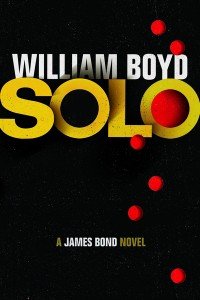
Solo is the latest of the James Bond continuation novels, which far outnumber the original books but have never matched Ian Fleming for unflinching brutality, thrilling action sequences and an obsessive accretion of period detail relating to fine dining, men’s tailoring and posh booze.
William Boyd’s Bond is an ageing spy, now 45, living off the fashionable King’s Road in swinging 60s London… and perhaps a little bored. As the book begins, his role seems to be more civil servant than super spy and he even gets tetchy with his boss M’s secretary, Moneypenny, an instance where Boyd distances his novel from the playful banter of the films.
Of course, Bond finds distractions including a solitary evening of over-indulgence at the Dorchester to celebrate his birthday. Given that his private party comprises two dry Martinis, a bottle of 1960 Taittinger Rose, pan-fried Scottish scallops in beurre blanc sauce, a bottle of Chateau Batailley 1959, fillet of rare beef and pommes dauphinoise, it would be remarkable if this sozzled, middle-aged Bond could run for a bus let alone exercise his licence to kill.
Not that 007 is likely to use public transport if he can help it. While Boyd has knocked off some of the rough edges from Fleming’s Bond, who held the sort of opinions you might expect from someone born in 1924, he’s still a devoted petrolhead. In Solo he’s fallen in love with the Jensen FF sports car, describing the roar of jet propulsion as he motors down the A316 towards Richmond for a potential dalliance with a B-movie actress.
Boyd’s opening to Solo is pure pleasure, the measured prose inducing a prickling of recognition at a character that first appeared 60 years ago. The title refers to an unauthorised lone mission, though before that happens Bond’s sent to the fictional west African state of Zanzarim on what seems a hopeless job to avert a protracted civil war by assassinating the genius general who’s helping the south hold out against the superior forces of the north. He’s surprised to be met by a young woman, Blessing Ogilvy-Grant, as head of station and the pair head south with Bond posing as a journalist for a French news agency accompanied by his translator.
The roadblocks into the Democratic Republic of Dahum don’t prove too much of a problem, but the suspicious mercenary Kobus Breed does. Breed is a veteran of the Rhodesian Bush War and half his face is destroyed, one eye constantly weeping. He also has a penchant for hanging his victims from hooks. Bond wins him over with some spontaneous military prowess inspired by WWII during a surprise attack, and they maintain an uneasy truce while Bond acts the diligent reporter. Eventually, this dirty war gets even messier and, after some recuperation in Scotland, Bond continues his mission alone in Washington DC where he runs into the CIA, his old friend Felix Leiter and a few unfortunate street thugs.
Boyd is a fine stylist though his desire for realism is at odds with his surprisingly formulaic thriller and unconvincing ancillary characters. There are few genuine surprises within Solo’s linear yet opaque plot, which requires a long-winded explanation at the end of the book. “Just get on with it, 007,” as M might say.
Bond seems neutered in Solo, unable to cause offence or mischief as he once did. We might cheer his socking of a sexist Daily Mail foreign correspondent but it was more fun when he was winding up his superiors. His need to fussily mix his own salad dressing in a Washington steak restaurant is actually suggestive of obsessive compulsive disorder, though in fairness this vinaigrette fixation was a feature of Fleming’s novels including Moonraker.
Of course, Boyd was entitled to write his own novel rather than merely imitate Fleming, and his portrayal of the ageing spy’s crisis of confidence and WWII back-story is intermittently stirring. Solo offers an enjoyable few hours in which to reacquaint yourself with this enduring British hero. It’s just a shame that Boyd’s Bond is a bit of a bore.
Read William Boyd on James Bond here.
Jonathan Cape
Print/Kindle/iBook
£8.09
CFL Rating: 3 Stars