


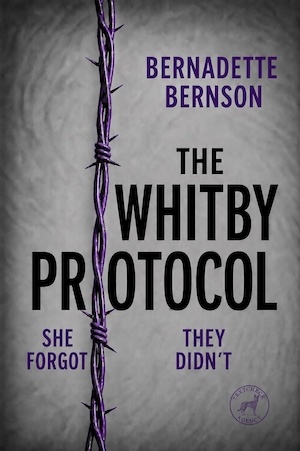
It’s fascinating how some novels come into being. The Whitby Protocol by Bernadette Bernson is a case in point. Writing crime fiction in English for the first time, the German author arrived in Whitby for a sojourn and was so taken by the personality of the town, the dramatic coastline and the vastness of the North York Moors, that it was like a new character had walked into her story. From the first page, Whitby and its surroundings are more than just a setting; they give the novel its unique feeling – and it’s one you’ll relate to if you’ve ever hiked on those moors.
Bernadette might be from Germany, but it’s pretty safe to say that she’s a Yorkshire-o-phile. As well as writing, she’s an editor and literary translator who brings thrillers and Regency novels written in English to the German market. But there’s another fascinating facet to her career as well. Between 2008 and 2015, she ran her own private detective agency. With the insight she gained investigating people with something to hide, it seems natural that she began writing thrillers. She’s been doing that since 2016, and The Whitby Protocol marks an evolution in her writing as it has been conceived entirely in English.
Inside, we meet DC Martha Rowe, a detective none to sure of herself for a variety of reasons. When boxes of old files are unearthed at a location on the moors, it sparks an investigation into what really happened at a shady research facility, and why. It soon becomes apparent that all of this will have a major impact on our protagonist. The novel is a police procedural that overlaps with psychological thriller territory not because the twists are there to freak you out, but because of the nature of this conspiracy – mind-bending experiments were going on, with very harmful repercussions.
We decided to invite Bernadette to join us here on Crime Fiction Lover for a chat about her English debut, how The Whitby Protocol came about, the characters you’ll meet, and plenty more too…
First of all, what are crime fiction lovers going to love about The Whitby Protocol?
I hope they will enjoy the combination of a British police investigation, a far-reaching conspiracy and a protagonist who cannot entirely trust her own memory. There are redacted files, missing test subjects, a Jane Doe on the moors and several people who are clearly lying – always a promising start to a working week.
Beneath the conspiracy, the technology and the secrets, this is a story about a woman refusing to let other people define who she is. However, while the novel may be dark, it is not entirely without humour.
Who is DC Martha Rowe, what inspired this character and how have you developed her?
Martha is a 28-year-old detective constable with North Yorkshire Police who has been transferred to Whitby after a covert operation in Sheffield went badly wrong. She shares many of my own character traits. Like me, she comes from a dark childhood, yet remains determined not to let her past define her and always strives to be a good person. I wanted her to be intelligent and resilient but never invulnerable. As the story progresses, she must rely on her instincts while questioning whether her memories – and therefore her sense of herself – are real.
What is she up against in The Whitby Protocol?
Martha is up against PALISADE, a secretive organisation powerful enough to erase records, manipulate evidence and make people disappear. Yet her most dangerous adversary may be the uncertainty inside her own mind, because it is difficult to investigate a conspiracy when you cannot be certain whether your memories are clues or carefully planted distractions.
Who are some of the other interesting characters we’ll meet?
There is Martha’s formidable superior, CI Leonard Hargreaves; her loyal colleague PC Ethan Rowley; and Tom Hensley, her hacker ex-boyfriend, who is extremely useful and not remotely forthcoming. Readers will also meet the elusive Ellie Mercer and Regina Reeves, two women whose connections to the past gradually become crucial. Almost everyone knows more than they are saying, which made them tremendous fun to write and would make them exhausting dinner guests.
Whitby, the moors and the coast are a big part of this novel. What made you choose this setting and how have you used it to create the atmosphere?
I travelled to Whitby with a friend, intending simply to work on the manuscript in peace, and by the end of our first day I had rewritten the setting around Whitby and the North York Moors. The cliffs, the sudden fog, the narrow streets and the vast, exposed landscape gave the story exactly the atmosphere it needed. Whitby is beautiful, but it also has the useful quality of looking as though it knows something it has no intention of telling you.
Music, particularly 1980s synth-pop, forms an unusual soundtrack to Martha’s investigation. Why was that music important to you, and what does it reveal about her?
Martha often listens to 1980s synth-pop through one earphone while she works, and songs such as Fade to Grey, Tainted Love and Blue Monday become part of her private world. The music gives her something familiar to hold on to while everything else becomes uncertain – although choosing Tainted Love as emotional reassurance may suggest that Martha and I both have questionable judgement.
There’s also this creepy Calder Institute that crops up. What can you reveal about what happened there, and the conspiracy to cover it up?
The Calder Institute near Goathland once presented itself as a respectable research establishment, but its work went far beyond anything its subjects had knowingly agreed to. When the abandoned building is demolished, a sealed box containing redacted files and photographs is discovered. Those documents suggest that Calder was not an isolated experiment but part of something much larger – and very much alive.
Memory and how much we can trust it are key themes in your book. Why did you want to explore these areas, and what are some of the other themes that interested you?
Memory is central to our identity, yet it is alarmingly unreliable even without outside interference. I wanted to explore what happens when someone realises that her most personal memories may have been manipulated, and whether she can still trust her own judgement. Beneath this runs another theme like a background frequency: Martha’s lifelong and seemingly futile search for love, and the longing to be truly seen and accepted – a feeling almost all of us recognise. The novel also explores consent, institutional power, loyalty and the uncomfortable question of who benefits when the truth is buried.
You’re a German author, so what made you want to write in English?
I have always loved British crime dramas: the dry humour, the eccentric characters and landscapes that can be beautiful and faintly menacing at the same time. The Whitby Protocol was British from the moment I conceived it, and the characters immediately spoke to me in English – Martha, in particular, showed no inclination to switch to German simply for my convenience.
A German edition will nevertheless be published on 5 November, although certain passages had to be adapted rather than translated literally, because this is a thoroughly British story and some of its language, humour and cultural nuances simply do not travel unchanged. I also secretly hoped to create a story that would lend itself perfectly to a television miniseries.
What are some of the crime fiction books and/or authors that have influenced you, and what are you reading right now?
Dean Koontz and Claire Douglas are two authors I greatly admire. Whenever either of them publishes a new book, I tend to have ordered it before common sense can intervene. The last novel I read was Lucy Clarke’s The Sea Sisters, and I am currently reading Heart of Glass by Jennifer Hillier.
What’s it like to have your debut in your hands at last, and what’s next for you and for Martha?
Holding my English-language debut at last feels wonderful, slightly surreal and a little like releasing classified material into the wild. I can certainly imagine continuing Martha’s story, not least because The Whitby Protocol ends with some doors deliberately left open. I am particularly intrigued by Tom Hensley, who reveals almost nothing about himself. Can Martha trust him? What does he really do? And is he actually one of the good people? A sequel could bring back familiar faces while introducing several new ones.
The Whitby Protocol goes on sale on 15 October 2026 for Kindle. You can order a copy with the buttons below.