



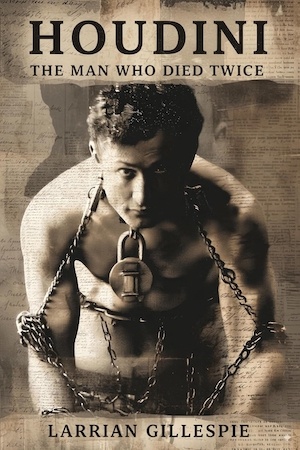
Los Angeles author Larrian Gillespie was a child actress during the Golden Age of Hollywood, grew up to become a surgeon, and wrote books about her area of expertise, urology. Following retirement, and entirely by coincidence, she became enthralled by the story of Harry Houdini’s death after she noticed significant gaps in official accounts of it. There was a mystery to solve there and she set about investigating it, writing everything down as she went along.
The result is the true crime book Houdini: The Man Who Died Twice, which comes out on 1 July 2026 but is already receiving plenty of acclaim. The story we all know – that Houdini died after being punched in the stomach due to appendicitis – is about to be blown out of the water. Larrian has discovered all kinds of evidence and some of it is quite unsettling. But I don’t want to spoil anything for you…
We invited Larrian to join us here on the site to talk about Houdini, her diligent investigation, and what it feels like to see your first crime book released into the wild in this fascinating interview.
First of all, what are crime fiction lovers going to love about Houdini: The Man Who Died Twice, even though it’s true crime?
They are going to love the fact it’s all true with never-discovered-before documents that reveal a plot like Murder on The Orient Express, only Houdini lived and died by it eight years before Christie wrote her novel.
What was it that fascinated you about Houdini and his story generally?
I actually had no interest in Houdini and was just doing a favour for a friend, building him a website on Houdini when I saw the death certificate and immediately knew it was a fraud. That led to more curiosity and that led to discovering the secret serum Houdini had been given… and the story goes on, like pulling the thread on a sweater.
And, when you looked into it, which discoveries did you make that made you really question the received mythology?
I talked with the Head of Fraud at the Vital Statistics Division in Detroit, who then re-examined the many factors I pointed out on the death certificate, and he recognised and confirmed it was a fraud. After that I knew there was a story here and I just had to find the answers. Coming from a show business family – my sister Darlene was one of the original Mouseketeers – I knew how legends were created by studios and families to sweeten the truth.
What sources did you use for your research and how did they strip away at the ruptured appendix (after the punch in the gut) conclusion to the case?
I actually taught myself to Vibe Code out of necessity, as I needed a database that would eventually hold over 2500 pieces of information on Houdini that I found in archives, newspapers, collections, museums and talking to well-known Houdini experts. I kept writing in daily sequence so you actually follow me along as I discover new items and understand and interpret them from a medical perspective. Appendicitis is a well known condition, so it was much easier as a surgeon than you would think to see the cover-up for what was a more heartbreaking cause of his abdominal pain.
Who are some of the interesting people who appear in your book and what did they contribute to the case you’ve built?
There are so many – dead and alive. H Elliott Stuckel has never been profiled before, and he is critical to Houdini’s mythology. No one knew the true story of Sophie Rosenblatt, Houdini’s nurse and how she lied on her affidavit to get Bess the extra 500,000 in today’s dollars of the double indemnity payout. Living people were the original GOAT on Houdini: Patrick Culliton, who gave me a significant clue over enjoying two plates of escargot; John Cox, again one of the great experts on Houdini, sharing information he had that might be relevant and more. They are profiled as my Houdini Watsons and Irregulars.
Some spiritualists were annoyed with Houdini because he was a rationalist. What were some of the tensions you uncovered within the spiritualist movement that you uncovered? Was that enough for motive?
The spiritualists were actually an hysterical part of the book, because the printed stories were so outrageous I was in tears over one of them. However, they played a significant part in why Houdini didn’t stop performing when he was in so much pain, as they were suing him and the theatre owners so that no one would let him perform. He also owed money to the Shubert Theatre Company and they had a pay-or-play clause that would have bankrupted him if he didn’t perform and sell tickets.
What kind of tone and atmosphere were you aiming for when it came to writing the text and styling it?
As a former child actress in the Golden Days of Hollywood, I knew how important it was to describe a scene and to share my own personal thoughts, which is not the style of a true crime nor a biography/memoir. So I wrote exactly how the tale was making me feel, and I think readers will be just as caught up in the story as I was writing it at the time.
Were there any wider themes that you wanted to explore, alongside the real life mystery itself?
The book is really about how legends, whether Hollywood or life, are never the real truth, and how sometimes it takes science to bring back reality. Houdini’s death was gruesome and horribly painful, yet the press and doctors portrayed him as conscious and speaking right to the moment of death, which was totally impossible given his bowel obstruction.
Which other crime books and/or authors have influenced you and why? What are you reading right now?
I am a great fan of Michael Connelly, Daniel Silva, Sherlock Holmes books and am a huge collector of gothic literature. I devoured Nancy Drew books as a child, and I think that inspired me to always question WHY in things that I saw or experienced in life and medicine.
What’s it been like for you seeing your debut nonfiction book turn from an idea into a reality?
It is oddly surreal that it has already achieved such acclaim. My editor and friend, Alanna Nash, who herself is an award-winning writer of biographies on Jessica Savitch, Elvis Presley, Dolly Parton and more, said it was a really good book. And Phoebe Larmore, another friend who shepherded all of Margaret Atwood’s phenomenal books, said it was exceptional but you just don’t believe it yourself until you are reading under the covers with a flashlight and say, ‘Ohhh that is really good’ when reading a particular line. I am extremely humbled that major critics have found that my presentation and style is so engaging and fun to read.
What’s next for Larrian Gillespie?
I have already written the first of a seven-part mystery thriller in the art world that I hope will be just as cinematic to my readers as Harry Houdini’s life story has been. I have also outlined another book that will explore the truth in relationships. Mysteries are all about pain and the world is full of pain right now.
Houdini: The Man Who Died Twice goes on sale on 1 July 2026. Order your copy here.



Great interview! Looking forward to the book.
Hi John – thank you!