

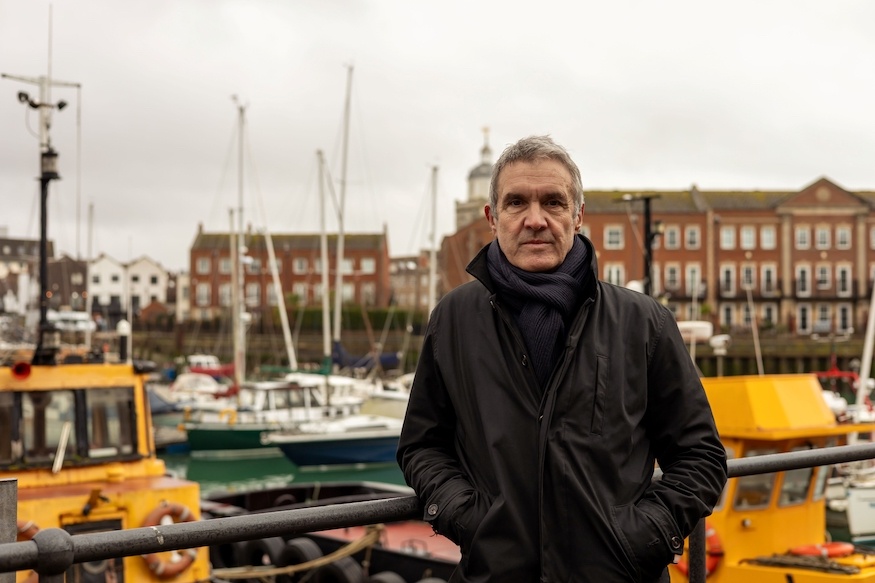
Horse racing. It’s an unusual route into crime fiction but it was a winning bet for former detective Toni Viola. One day, he answered an ad in a racing magazine and began writing articles about the sport. Books on the subject followed, and then he turned his hand to crime stories that draw on his Italian roots on his mother’s side.
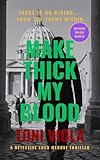
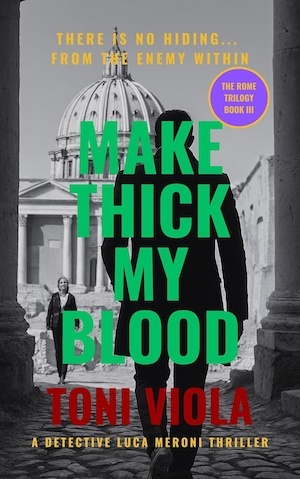
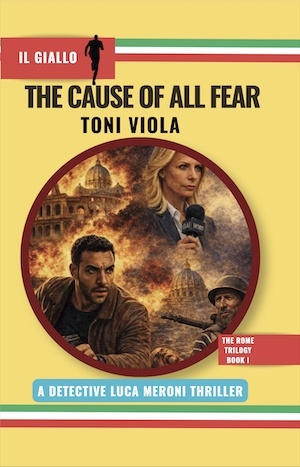
First, Toni brought out The Cause of all Fear followed by Nothing Can Be Loved. Both titles came out in 2025 and feature the Rome-based cop Luca Meroni. Now, Toni is completing the detective’s trilogy with Make Thick My Blood, out on 29 May 2026.
Born in Portsmouth – AKA Pompey – on England’s south coast, Toni is still based in Hampshire and you might notice the odd reference to his home town in his work. He’s a proud independent crime author, a member of both the Alliance of Independent Authors (ALLi) and the Crime Writers’ Association (CWA) and has built a strong following for his thrillers. There are plenty more to come.
Read on as we chat to Toni about his books, his characters, his inspirations and his future projects…
What are crime fiction lovers going to love about Make Thick My Blood?
I would like to think the book contains all the key tropes that go to make a good thriller: corrupt police, scheming politicians, devious lawyers, multi-layered back stories, red herrings – or falsa pista as the Italians say – shock, awe, et cetera. But of most importance are credible characters, and I have endeavoured to bring a full-bodied cast to the story that readers are familiar with. There are many twists and character arc turns, and I hope the novel brings The Rome Trilogy to a perfect resolution for the reader and leaves them wanting more.
Who is Luca Meroni? What inspired the character and how have you developed him?
Like all good detective leads, Meroni is flawed. I spent a lot of time developing his character in The Cause Of All Fear, book one, to avoid him becoming a cliché. We all know the type: the hard-drinking, womanising loner on the nowhere road to redemption. As a teenager, recklessness ended Meroni’s football career; likewise, he blew his undercover cop career. It is almost impossible to avoid the stereotype completely. When my daughter was reading the second book, Nothing Can Be Loved, she said she was growing to dislike him, but he won her over in the end. My daughter holds a Master in English and acts as my sensitivity reader by proxy. I would like to think that whilst he is a complex character, Meroni is someone the reader will root for.
What’s he up against in Make Thick My Blood?
Spoiler alert…
In the first chapter, the reader finds out that someone attacked Teresa Conti, Meroni’s on/off lover and a big player in the previous books, and left her for dead at Pompey’s Theatre – I had to get the reference in. The assault links to two other bizarre incidents at the Roman Forum. In these incidents, attackers drugged the victims and left them in a bloodied state dressed wearing togas. At the end of the chapter, Meroni gets arrested. To prove his innocence, he must defeat the enemy within his own organisation. Let’s say the stakes are high from the off.
Who are some of the other interesting characters we’ll meet in the book?
My father served in the Royal Navy, so my mother raised my brother and me for most of our childhood. My mother was Italian, and the key female characters in my books are all strong independent women: Teresa Conti, Rome’s chief crime correspondent; Roberto Russo, Meroni’s omnipresent sidekick; Tina Ferrara, Meroni’s ex-lover and now line manager; and Gaetana Ragallo, the deputy mayor of Rome who is very nasty. The enemy within who our protagonist must defeat could either be Meroni’s boss, Chief Inspector Gambarella, Investigator Andrea Crisanti, Meroni’s nemesis throughout the series, and/or his own demons.
What role does the Roman setting play and what kind of atmosphere have you tried to create?
Rome is my favourite city in the world. It has fascinated writers for centuries and tales of political intrigue, deep-rooted rivalry, unrequited love and violence plague its history. But Rome is love, Roma is ‘amor’ spelt backwards. The city is, as portrayed in the Paulo Sorrentino film, the ‘Great Beauty’. Apparently, one reason William Wyler shot Roman Holiday in black and white was to avoid the city upstaging Audrey Hepburn, who at the time was a relatively unknown actor. Of course, Wyler’s scheme failed because Rome cannot simply act as a backdrop to any film or book narrative. Through Meroni’s character, I have tried to capture the essence of everyday life in Rome. The fact he spends a lot of his time drinking coffee in bars is not an affectation, it is what people do throughout Italy as part of the everyday. I was in Pepy’s Bar in Piazza Barberini two years ago with friends, at one o’clock in the morning. About a dozen police cars pulled up on blue lights and the cops piled in for a coffee!
Do we need to have read the earlier novels in the series to enjoy this one?
As with any trilogy, it is best to start at the beginning, which – as Meroni says in one of the concluding chapters of the latest book– is ‘a very good place to start’ because ‘Rome’s seven hills are alive with the sound of death’. I must credit Rodgers and Hammerstein for that line. Yes, readers can dive straight into the third book, as I do my best to provide the background from the other two novels, without giving too much away. But it would be best to buy them all and read them chronologically!
What are some of the bigger themes you wanted to explore?
That’s a good question. The title of the book comes from Macbeth. A key character in the book is Gaetana Ragallo, and she is ruthless in her resolve to become Mayor of Rome. In the story, politics and corruption are the dark forces that Meroni is up against. I am a retired detective. I spent a lot of time at Crown Court and was proud to achieve positive outcomes. But the courtroom in England and Wales is an anachronism, a theatrical playground for lawyers, and like Meroni it is deeply flawed. However, evidence is key, it is the investigator’s Holy Grail. It is a simple principle, but there are lots of moments in the Meroni books where flawed evidence and dishonesty get their comeuppance. Remember, the good guy must win – sometimes…
Which crime books and/or authors have inspired you and why?
I am currently reading a book called The Serpent’s Bridge by an American author called SZ Estavillo, as she reached out to me for a book swap. The book is based in Los Angeles and is a deep-dive into cultural tension and the LAPD investigating race crime and combatting racism within the organisation. The author’s father was a police chief, and the procedural parts read well.
I have read all the Sherlock Holmes stories – Conan Doyle was a Pompey goalkeeper, I wonder how many readers know that? – and had many links with the city of Portsmouth, so Holmes is a favourite. I love Amor Towles, whose books are magical. Thriller wise, Michael Connelly writes great courtroom scenes, and I have read most of the classics: The Bone Collector, Kiss The Girls, The Day Of The Jackal, et al. I read a lot of book samples from the books featured in the CFL Rap Sheet. This helps to give me a flavour of other writers’ craft and avoids filling my head with the full plot, which might be a bit of a blocker for my own ideas.
As Meroni’s trilogy ends, what’s next for Toni Viola?
I already have a working title for the first book in The London Series which will see Meroni come to live with his estranged father in Finsbury Park – The Imitation Zone. It is a lyric from a well-known Clash song, and the last line of Make Thick My Blood. I have written a short story, Careless Talk, which is set in World War II and was published on the Crime Writers’ Association website. There are tentative plans to write a collection of stories about the experience of the Italian people in WWII, to redress the negative stereotyping. But I am mainly concerned with trying to produce original crime thrillers and building on the first three Meroni books.
Make Thick My Blood is published on 29 May 2026. Guarantee your copy with the button below.