

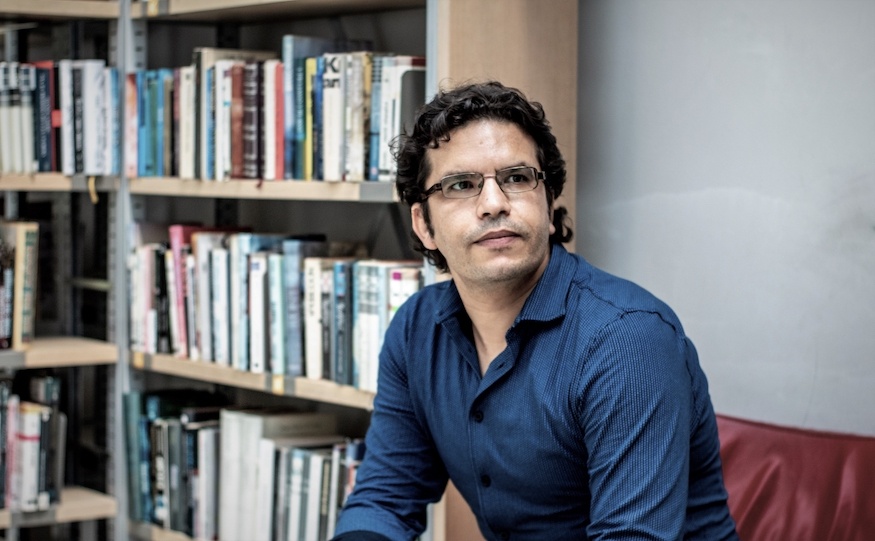
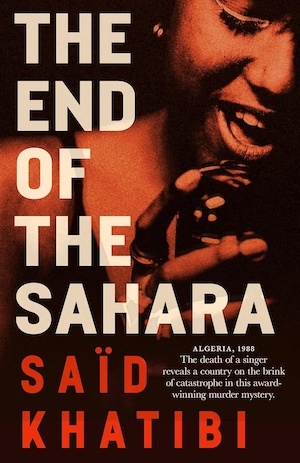
Today we welcome Saïd Khatibi to the site – author of The End of the Sahara and the winner of the Sheikh Sayed Book Award for Young Authors in 2023. Saïd is the first Algerian author to ever appear on Crime Fiction Lover. It’s an exciting time for anyone who loves to explore the world through crime fiction, and it’s exciting to think that other North African and Arab crime authors might follow in Saïd’s footsteps.
The End of the Sahara is a whodunnit that takes place in 1988 over the backdrop of the civil unrest that swept Algeria that year and preceded a decade-long civil war. Singer Zakia Zaghouani lies dead on the edge of the desert, and her boyfriend is immediately arrested by the police, led by the incompetent Inspector Hamid. It falls to the suspect’s defence lawyer, Noura Arkoub, to investigate the case. But what is it like for a woman to try and solve a murder in Algeria during this period in its history? That’s one of the many fascinating things about this novel. The book has been translated by Alexander Elinson.
So, let’s meet Saïd Kahtibi…
First of all, can you tell me a bit about your background?
I was born and grew up in Algeria, in the Sahara, between sand and sun. For the past few years, I have been living and working in Slovenia, where the sun is rare. A contrast. I grew up during the civil war in Algeria in the 1990s.Violence was everywhere. I learned to tell the difference between weapons before I learned how to write love letters to my high school girlfriend.
What are crime fiction lovers going to love about The End of the Sahara?
A different world, with no snow and no rain. A desert environment where it is very hot. One crime can lead to others, and ordinary people can, at a certain moment, become powerful and turn into criminals. They will also meet EM Hull, the most famous British author of the 1920s, who stayed in my town in Algeria. But in my novel, I discuss her novel The Sheik and try to correct her orientalist view of Arabs.
Who is Noura Arkoub? What inspired and how have you developed this character?
She is a bit like an Arab Diana, Princess of Wales. She wants to be beautiful, to be recognized and accepted. Unlike Diana, however, Algerian society does not look kindly on powerful women; it prefers men. She tries to solve a crime, but ends up becoming involved in it.
What is she up against as she tries to solve the murder of Zakia Zaghouani and exonerate Zakia’s boyfriend?
In this novel, the victim is a woman, and the one leading the investigation is also a woman. The men try to stop the investigation. I still believe in the role of women, in a society that tries to make them invisible.
Who are some of the other interesting characters we’ll meet in The End of the Sahara?
A VHS cassette seller, a police commissioner, a singer and the guests of a hotel in the desert. It is the same hotel where Karl Marx once stayed. Karl Marx was famous for his beard, but the only time he shaved it off was when he arrived at this hotel, because of the heat.
You chose to set the novel in Algeria in 1988 during the Black October protests. What interested you about this period in the country’s history and what role do events and the setting play in the storyline?
On 5 October 1988, Algerians took to the streets to protest against the socialist regime. The result: about 500 deaths, including a neighbour of ours who was wounded and left disabled by a bullet. No one ever told me about it because he was disabled. At the age of 21, I learned the truth and discovered the story of this massive protest – a moment in the country’s history had been completely erased from memory.
Until now, there hasn’t been a novel about 5 October in Algeria, about the first protest against socialist regimes in the world.
What kind of atmosphere did you want to evoke for readers in and around the Sahara Hotel?
This hotel is like an entire country. All kinds of people come there. It is a hotel where plots are hatched, drugs are sold, and assassins roam. It is also a place where parents arrange marriages for their daughters against their will.
We see so little crime fiction from North Africa or the Arab world. From your perspective, how does it compare to Western crime fiction?
The future of Arab literature is the detective novel. The Arabic detective novel is different from Western ones. It is more human, with more smells and colours, also more humour.
What are some of the bigger themes you wanted to explore in the novel, and why?
The impact of collective history on individuals, the role of women, traditions and modernity
Which other crime authors and books have inspired you, and why?
The Thousand and One Nights can also be read as a detective story, it has all the elements. I read many contemporary authors. I also remember Naguib Mahfouz, the only Arab to win the Nobel Prize in Literature, which he did in 1988, who published a beautiful detective novel in 1961called The Thief and the Dogs.
The End of the Sahara goes on sale 26 February 2026 from Bitter Lemon Press. Get your copy using the buttons below, and watch for our review, coming soon.