

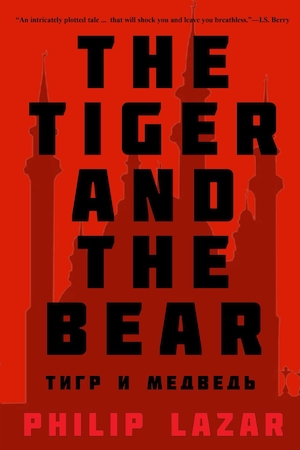
Espionage fiction is at its best when it responds to current geopolitical events in new and interesting ways, and debut author Philip Lazar does just that with The Tiger and the Bear. It feels like a story that could easily happen. Because so much of the news these days seems to be a toxic amalgam of ill will and deception, just when you may be wondering what’s really going, the novel suggests ‘it might be this.’
Lazar’s story begins in Washington, DC, when Russian-speaking policy writer Paul Girard is handed a document by a junior congressional staffer. The aide’s boss is a back-bench first-term congresswoman from a southern state, the very definition of no clout. Yet she wants the information in the document to ‘get out.’ Paul is no longer a reporter, but the staffer insists he still has connections and turns to the document’s last page. There, Paul sees the signature of Oleg Makarov, an old friend from when he and his buddy Gunther Schroeder were reporters in the Soviet Far East. Gunther is still in the news biz, high up in a prominent Washington newspaper.
Later that day, Paul shares the document with his wife Elise, experienced in government investigations, and Gunther himself. All three immediately recognise its significance as it describes in detail plans for the secession of the Russian Far East from the mother country.
No wonder it’s a secret report – such a move would destabilise the Russian government and throw a huge part of the world into turmoil. Russia could be expected to counter with force, and stopping the likely actions and reactions of world powers might be impossible. That’s what the document could do. But is it real?
They agree that it could be real, it could be fake, it could be a lot of things. But it’s too important not to follow up. Paul and Gunther’s journalistic habits impel them to try to check it out, somehow. That won’t be easy. Through their conversation, Lazar provides the arguments and counterarguments for the document’s veracity, a convincing show of the journalists’ clear-sightedness.
They cannot quiz leaders from the purportedly dissident area, who would inevitably deny knowledge of the plot. And they have to be careful not to set off the powder keg themselves by mucking around. Their best bet seems to be to find their old friend Makarov. They’ve been out of touch with him for a number of years, but Paul still has his investigative instincts and those highly valued contacts, and Gunther is willing to pay him to dig.
The hunt for Oleg takes Paul and Elise to Rome and eventually to the Far East. As they are following Oleg’s tenuous trail, separate chapters detail his flight from Russia. He obviously fears the authorities know about his involvement with a consequential report and that he’ll not only pay for it with his life, but the world will never know in time. Excellent sword-of-Damocles writing here.
Lazar describes Washington, DC, culture well, and with his persuasive descriptions of Rome, Thailand, Cambodia and elsewhere, you feel right there with Paul and Elise on this perilous adventure, only one step behind Oleg.
Of course, the reporters have problems. One of the biggest is a former television newsman, booted from his job, now hired by the newspaper as Gunther’s go-to person on national security stories. Guy Lynch comes from a world of almost-fluff news and doesn’t know what to make of the document Gunther describes to him. But, as a self-proclaimed intelligence community insider, he does tell his CIA contact about it. This propels CIA to examine its own audio, video and human intelligence resources. While they dismiss Lynch as a lightweight, they conclude, much like Paul and Gunther, that they’re obliged to follow up.
Quite a few cats and mice are in the game now. Lazar describes in frightening detail the extent to which the Americans’ actions are being monitored: their flights, hotels and phone calls. It seems only a matter of time until they end up in trouble, or Oleg does, despite the many precautions they employ. Lazar has put this plot together so well that it is thrilling to read, the kind of ‘just one more chapter’ tale that will keep you up late at night.
Also see The Protocols of Spying by Merle Nygate or The Seventh Floor by David McCloskey.
The Agency Books
Print/Kindle/iBook
£17.64
CFL Rating: 5 Stars