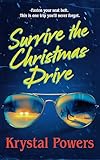


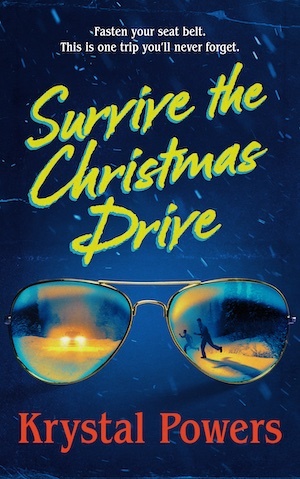
Krystal Powers’s Survive the Christmas Drive is a holiday-set thriller built on a simple but effective premise: a young couple on a long holiday drive, a brutal Midwestern blizzard and a group of escaped killers somewhere out on the same icy roads. It’s a self-contained, high-tension story about a night where everything that can go wrong does.
It’s 23 December, 1985. Tim and Blair, a young couple from Omaha, are driving to Cedar Rapids, Iowa, for Christmas in their new Jeep Wagoneer. It’s a trip they have done before, but that familiarity is part of the issue: it’s routine, almost boring, the sort of long holiday drive many people dread because of traffic and family obligations waiting at the end.
But then the weather turns.
A severe storm rolls in, the temperature drops, the snowfall thickens and their comfortable assumptions about getting to their destination on time start to disappear. As they creep along Interstate 80 in worsening conditions, news begins to filter through on the radio and via the newfangled car phone about a prison break.
Four convicted killers are on the loose, and somewhere up ahead or behind, unseen in the snow, they are sharing the same dark highway as Tim and Blair. Even more worrying, Tim was the lawyer for one of the murderers, and being sent to prison for life certainly didn’t endear his legal team to him.
One of Survive the Christmas Drive’s most enjoyable elements is its time-capsule setting. Powers chooses 1985 not just for nostalgic window dressing but because it serves the story. This is a world before smartphones, GPS or easy ways to call for help. If a person gets lost or stranded, they really are on their own.
The cultural details – hit songs on the radio, big cinema releases, must-have gifts of the season – situate events in that era without it feeling like a parody of the 80s. Such details also underline how much harder a survival situation is when it’s not possible to simply tap a screen to find a motel, check the radar or call emergency services.
The result is a thriller in which getting to the next exit or finding a payphone is a major achievement rather than an afterthought. Plus, 1985 is firmly within the so-called ‘golden age of serial killers’ in the US, which goes some way to explaining why so many oddballs are out and about on the interstate that night.
The winter landscape itself becomes a kind of antagonist. Powers makes excellent use of the blizzard setting, turning the open road into a claustrophobic, hostile space. Snow, black ice, fading lane markings and swirling whiteout conditions strip away the sense of freedom usually associated with a road trip.
In the dark, with the visibility shrinking to a few metres, every headlight appears ominous, every rest stop and country road exit potentially dangerous. The storm is not just a backdrop – it is an active threat that shapes the couple’s decisions and limits their options. The cold seeps into the car and the wipers squeak in vain over a windshield that will not stay clear.
Tim and Blair are intentionally ordinary, a pair of upwardly mobile young professionals whose lives have followed a comfortable, optimistic trajectory. That ordinariness is key to their appeal. They are not trained operatives or hardened investigators. Much tension is derived from watching them adapt to a situation far beyond anything they have prepared for.
Their marriage is put under a microscope by the stress of the night. Conflicts that might normally be small – over directions or how much to trust strangers – become deeply consequential. Powers shows how fear and fatigue can distort perceptions and trigger arguments, and how a partnership can harden into something stronger in the face of danger.
By comparison, the escaped prisoners are drawn more as looming threats than as fully explored psychological studies. They represent menace and unpredictability rather than serving as the emotional core of the story. This choice keeps the focus firmly on Tim and Blair and maintains a certain simplicity.
Still, villains with more intricate backstories or greater moral ambiguity would likely have seemed more immediately threatening. However, as Powers does not slow the narrative to delve deeply into the antagonists’ inner lives, the momentum rests squarely on the couple’s attempts to survive.
The pacing supports that focus on momentum. The short, tense scenes often end on small cliffhangers, creating an almost episodic rhythm. The structure of the story also matches the couple’s journey: there is a sense of steady forward movement, frequent hazards and no real chance to pause and catch their breath.
Plus, the story stays close to the central thread of the drive rather than branching off into elaborate subplots, official investigations or side stories, although this does mean that the many strange encounters over the course of the journey appear fleeting and worthy of further exploration.
In this way, Survive the Christmas Drive explores how fragile normal life really is. At the outset, Tim and Blair are doing something utterly mundane: going home for Christmas, with gifts in the car and family expecting their arrival. The sudden intrusion of catastrophe drives home how easily the routines of daily life can be shattered.
The Christmas setting adds another dimension. It is supposed to be a time of comfort, warmth, abundance and togetherness, but it becomes the backdrop to a story about isolation and mortal danger. The contrast between festive expectation and brutal reality gives the story much of its emotional charge.
Powers focuses on clear description, snappy dialogue and straightforward action rather than on stylistic flourishes or experimental structure. The 1980s elements and Christmas touches are artfully sketched, evoking the setting and atmosphere of building dread without slowing down the pace.
Hence, Survive the Christmas Drive offers a strongly evoked retro setting, a convincingly hostile winter landscape and a straightforward but gripping survival plot anchored by a believable central couple. It is not a puzzle-heavy whodunnit, nor is it a cosy mystery with a gentle festive wrap-up.
Instead, it is a winter road-trip nightmare that uses the trappings of Christmas to heighten the contrast between what the characters expect from their holiday and what they actually receive. It’s a seasonal story that delivers tension rather than sentimentality, and the journey makes rush hour on the M1 seem not that bad at all.
For more Christmas-set crime stories, check out our roundup of recent festive releases.
Clever Line Media
Print/Kindle
£3.99
CFL Rating: 4 Stars