

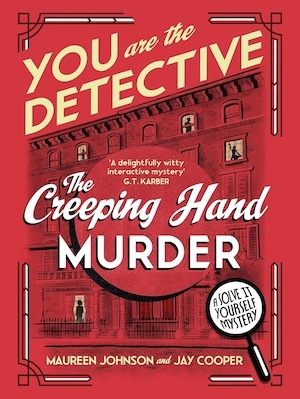
The crime at the heart of The Creeping Hand Murder, from the You Are the Detective series, is the exact opposite of a locked-room mystery. The deed takes place in a drawing room full of people. Many characters had opportunity, means and motive, with the stabbing occurring beside the fireplace during a sumptuous soiree. There’s an abundance of eye witness statements and physical evidence. But it’s not clear exactly who the culprit is.
Before going further, it’s essential to establish that this is not typical crime fiction. You’re advised to read from the start to the end, but The Creeping Hand Murder does not tell one cohesive story in the traditional sense. There is no heroic central detective. This is a solve-it-yourself mystery with the Metropolitan Police tasking you, the reader, with identifying the killer. It’s not a choose-your-own-adventure style branching narrative, though. This is a casebook of pictures and interview transcripts, and you digest it all, then decide who did it, how and why at the end.
The book contains the specifics of a murder that took place at an elegant London mansion in the 1930s. American novelist Roy Peterson – by all accounts a pompous man and a drunkard – was stabbed to death during a society gathering in Mayfair, despite being surrounded by six witnesses who’d been summoned there by mysterious letters, and who all claim no one approached the victim during the evening. The police are baffled by this seemingly impossible crime, with the murder weapon found under Peterson’s chair and no explanation for how he could have been killed in a room full of people, leading to speculation about supernatural involvement and the case being dubbed the ‘Creeping Hand Murder’.
What we have here is a well-made hardback tome that’s more of a playful experience than a traditional novel; its neat, heavy pages overflow with details about people and places in November 1933. The story unfolds through a scattering of ephemera – newspaper clippings, letters, photos (actually charming line drawings), police reports, testimonials and so on.
A sealed envelope at the end – which contains a note of confession from the true killer – is your solution, and you must only open it when you’ve made your own conclusions. It’s like a complicated game of Cluedo where you are the only player.
It’s by Maureen Johnson and Jay Cooper. Johnson is a bestselling author of many young adult books, including the Stevie Bell mysteries, as well as Let It Snow with John Green and Lauren Myracle (which was adapted into a movie on Netflix). Cooper, meanwhile, is better known as a children’s illustrator and graphic novelist with contributions to the New York Times. Together they’ve created something which feels partly like an Agatha Christie novel and partly like an after-dinner role-playing game.
It’s liberally sprinkled with humour, from the almost-parodic character types to some of the throwaway notes and descriptions. One inebriated witness confesses to “trying to exit the house through the piano”, and a local eccentric’s house is found with 74 squirrels living in it. There’s an interview with the victim that makes him sound almost cartoonishly pretentious.
It’s in this humour that there’s a tonal clash. The illustrations are sketches of people and places in the style of newspaper caricatures. The throwaway jokes and the diagrams of what’s in people’s pockets give it the feel of a children’s book at first glance. It is fun… but it tells a story of drugs and death. The surface detail is all interbellum frivolity, but there is something dark here: hedonism, jealousy and violence. It works as a whole if you can align yourself with its distinctive style.
The crime itself is ingenious and manipulative, and hinges on a sequence of events in which there are a lot of variables at play, making it improbably hard to pull off. As always in these cases, that’s the joy of it! If we have one piece of advice for you, it’s this: take notes as you read. The context of the murder becomes apparent pretty quickly, including the interrelated past histories and passions of the main suspects, but you’ll need to become the kind of fastidious detective who notices details and flips back to see if something was mentioned (or omitted) earlier. There are some big hints about the reasons for the Why?, but your gut will only take you so far in terms of the How?, and some of the pertinent elements won’t make sense when they’re glimpsed out of context, only if you can tie threads together later.
One minor flaw is that this beautiful book doesn’t have page numbers, which can be disorientating if you’re flipping back and forth to check statements.
Overall, it’s a preposterous, puzzling story, presented as a dossier, with high-quality production values and a mischievous tone. Character development is almost comedic in places and takes a back seat to world-building. But it’s a delightful read and would make an excellent gift for any budding Poirot in your life.
Ten Speed Press
Hardcover/eBook/Kindle
£12.49
CFL Rating: 5 Stars