

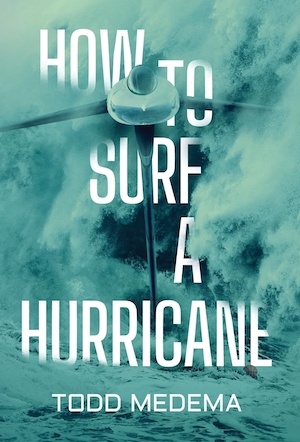
Reading a debut novel like Todd Medema’s How to Surf a Hurricane offers a bit of an extra thrill. Not only do you experience the events, characters and settings of the story itself, but you also see a process of writing at work. Yes, maybe some writing skills need polishing, but you can see the gem that lies underneath, the writer the author could become. It’s probably how people felt back in 2009 seeing Lin-Manuel Miranda’s rap about Alexander Hamilton, which eventually flowered into the musical Hamilton. The energy is there.
This eco thriller follows several tracks. In the main track, young American engineer Moro Petroff is trying to develop an efficient battery that will end reliance on fossil fuels, the mainstay of his wealthy family’s energy business. But his uncle, head of the company, says Moro’s quest is too expensive and possibly, hopeless. He plans to cease supporting his experiments and to destroy the prototypes being shipped from Europe.
In another principal track, Victoria and her teenage daughter Azure live on a sailboat in Baja California Sur, teaching sailing. They’re happy there, but changing circumstances mean they must move on. Victoria plans to sail around South America, visiting its diverse countries and end up in Miami. Months later, near the end of their trip, they encounter a small hurricane and meet up with another boat supporting a hurricane surfer who’s taking aim at speed records. She’s not using a traditional surfboard – too dangerous – but a jetfoil whose wings can rise above the water, decreasing drag and increasing speed. Victoria, an inveterate adrenaline junkie herself, has to try it. One ride and she’s hooked.
Moro, worried about the imminent destruction of his prototypes, realises the family company has put the brakes on other creative projects around the world that potentially threaten its accustomed way of doing business. Projects they’ve quashed suggest ideas they’re afraid of, ideas and innovations he may be able to use. He calls on the talents of several college friends who help him put together the pieces of what will be the unprecedented theft of the container loaded with his batteries from a ship in mid-ocean. His plan involves nothing so crude as paying off the captain and crew, who couldn’t be relied on to keep the theft quiet.
No, he needs a hurricane. And a hurricane surfer.
Like one of those complicated Las Vegas heist films, there’s a team. And each team member has a job to do – whether it be to operate finicky equipment or to distract the container ship’s crew – and their timing and execution must be perfect. The whole adventure at sea is meticulously imagined, vividly described and mostly clear to a non-engineer like me. By the time the wind died down, I was exhausted!
The complications for Moro are not over, however. There’s more, good and bad, to come.
I enjoyed the characters Medema created for several of the secondary roles and found them diverse and interesting. While Moro, enthusiastic, stubborn, naïve, is pretty believable, and I really liked the engineer Patty whom Victoria found to help her design her own hurricane surfer, Victoria herself was not terribly convincing. I especially don’t know how she could have carried on after a serious accident during the storm. Dialogue is something Medema may want to work on for future books, but he’s off to a strong start with this one. Already he can create a complicated and thought-provoking plot and describe events well.
This author has a utopian vision for the way an ideal society would work, which is refreshing in an era when so much appears to be on the wrong track. Patty, the engineer, may be just the kind of person who could accomplish it.
This is an interesting new take on the eco thriller. Also see the work of Canadian author Paul E Hardisty.
Atmosphere Press
Print/Kindle
£13.53
CFL Rating: 3 Stars