



Like many of the authors we meet, Daniel Yager put aside his writing aspirations after law school and focused on putting food on the table for his young family. However, reaching semi-retirement, he returned to his keyboard and on 5 August 2025, Daniel’s debut crime novel hits the shelves.
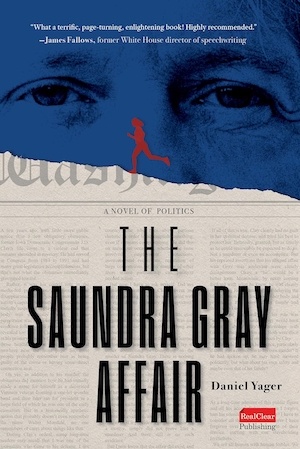
The Saundra Gray Affair is a thoughtful political thriller as well as a commentary on modern politics, the media and the public’s rush to judge people based on incomplete information. The story begins in the early 1990s and centres around an ambitious congressman, JD Clay, who’s caught in the maelstrom when the woman he’s been having an affair with disappears.
Though he grew up on the plains of Kansas and Nebraska, the book is filled with Daniel Yager’s deep understanding of the political and media landscape in Washington, DC, where he worked for 50 years with a lobby group called the HR Policy Association. Part of Daniel’s inspiration came from a real life case – that of Chandra Levy, a Washington intern who disappeared in 2001 and whose case has never been solved. We invited Daniel onto the site so we could find out more about the inspiration behind his novel, its characters and his wider message.
What are crime fiction lovers going to love about The Saundra Gray Affair?
To me, the best crime fiction includes more than simply a whodunnit, whether it’s historical detail, psychological perceptions or other insights the author can share. Readers of The Saundra Gray Affair will find not only a damn good story, but will also gain an increased understanding of both the good and bad of American politics and the lives of those who inhabit it.
In addition to enjoying a good crime novel, I hope the reader comes away realising the challenge in judging a person or situation based on a bare bones version of the truth. I strongly believe the essence of wisdom is knowing what you don’t know.
Who is JD Clay? What inspired him and how have you developed his character?
JD Clay is a highly effective moderate Democratic congressman from Iowa who seeks a middle ground on many critical issues rather than catering to the extremes. Before he falls into trouble with an affair, I establish him as someone who many voters now yearn for, with chapters showing his personal and political evolution, as well as his utter devotion to his disabled wife.
Who or what is he up against?
When the young intern with whom he is having the affair goes missing in 1990, he absolutely denies knowing anything about her whereabouts but neither repudiates nor confirms the affair publicly. He is then confronted by a media onslaught that foreshadows the 24-hour news cycle to which we have since become accustomed. Meanwhile, groups on the left and right seeking his defeat in the primary add fuel to the fire with even less concern for the truth than the media
Who are the other key players we’ll meet?
His chief of staff, Wally North, fights for Clay’s political survival while wondering if he knows the full situation. A prize-winning journalist, Isaiah Stone, fiercely defends Clay as innocent until proven guilty but is later compelled to seek the full truth behind Saundra’s disappearance. Another key role is played by an expensive call girl working her way through law school and with whom Clay falls in love.
It’s fascinating that you were inspired by real-world case that remains unsolved. Tell us more about why you were interested in the Chandra Levy case?
Anyone involved in politics quickly learns the frequent discrepancy between the truth and what is assumed in the public discourse. I wanted to illustrate that discrepancy with the book and, even at the time, I believed the Levy/Condit case was a prominent example. I took the basic contours of the case – missing intern, alleged affair, media firestorm – using fictional characters while making no attempt to portray the real story. There are two books that examine the facts of the real case for anyone interested: Actual Malice, by Condit and his lawyer, and Finding Chandra, by two Washington Post reporters
You decided to go well beyond the solving of the case and to look at the impact of what happened over the decades. Why was this important to you?
This approach aligns with my desire to go beyond just the whodunnit aspect of the story. I wanted to create a context that would help convey my perspective on politics overall and its relationship with the media. I felt this could only be done with an extensive timeline.
Politics and power are two of the big themes in The Saundra Gray Affair. What aspects of these topics did you want to explore and why?
I wanted to demonstrate the power of the media and how it is often driven more by dollars drawn from the entertainment value of the story than an attempt to get at the truth. The book also examines how this dynamic can play into the strategies of the various interest groups that can affect elections.
With so many questions remaining around the Epstein files, this seems a very pertinent novel. What are your reflections on how it relates to what we’re seeing in the news every day?
It is very relevant. The Epstein story and the alleged conspiracy to keep it under covers is driven by tidbits of information that don’t give the whole story and that could destroy careers and lives. It remains to be seen whether the release of all the heretofore confidential information allays this or just makes it worse. Hopefully, the truth will out in the end and only those of illegal or unethical behaviour will get burned.
Which authors and books have inspired you in the crime genre, and what are you reading at the moment?
Scott Turow novels focusing on ordinary people falling into perilous situations through circumstance and/or stupidity have always been among my favourites. Jeffrey Archer wrote a number of sagas about politicians that typically included a crime or corruption element. I love historical crime novels, so I am now reading the third in the Shardlake Series by CJ Sansom, Sovereign, where the ‘detective’ is a lawyer working in the court of Henry VIII.
What’s next for Daniel Yager?
I am kicking around a lot of ideas about another novel steeped in Washington politics and policymaking. Since I worked on Capitol Hill in the 1980s, it would probably be in that same setting, with some of the salient policy issues at the time forming the backdrop to a scandal or crime.
The Saundra Gray Affair is released 5 August 2025 and you can order a copy using the buttons below.




Best to be upfront about this. I have known Dan Yager for over 20 years. He is from the US, and I am from Europe. However, as we both worked in the field of labour relations, particularly with large US corporations, we came to know one another and became good friends. When he retired some years ago from the Washington-based HR Policy Association, with whom he had worked for over 30 years, I suggested to him that he should write a book. What I had in mind was some dull tome about his escapades working with Congress to get some law or other passed or, more likely, to have some law or other blocked.
Instead, he went off and wrote this humdinger of a political thriller, informed by his deep, insider knowledge of how Washington works.
Loosely based on real-life events, it tells the story of Congressman J.D. Clay, who could have been a presidential contender, an Iowa Democrat, war hero, and one-hit-wonder songwriter. As an aside, the novel is infused with Dan’s extensive knowledge of rock and pop, as well as his love of “Americana, his delight in dropping into a decent highway diner.
Clay’s political world falls to ashes when Sandra Gray, an attractive young intern in his office, disappears. Were they having an affair, was he involved in her disappearance? The Eastern European mafia even makes an appearance as the provider of sexual comfort to Washington’s rich and powerful.
This book is a real page-turner. Ideal as a holiday read, or on that next flight to wherever. Go buy it today.
Dan, now about writing that dusty tome…
Is this novel written in the first person?